Wholesale Latex Balloons / Wildlife Exposure / Event Use
Importers purchasing wholesale latex balloons from a manufacturer need to separate product specifications from environmental claims. A latex balloon can meet an approved manufacturing specification and still present a wildlife hazard if it escapes into the environment.
Event businesses sourcing wholesale matte latex balloons for controlled party decoration should determine how the balloons will be installed, supervised, removed and accounted for after use. A secured display can reduce opportunities for litter, but it is not a guarantee of zero exposure.
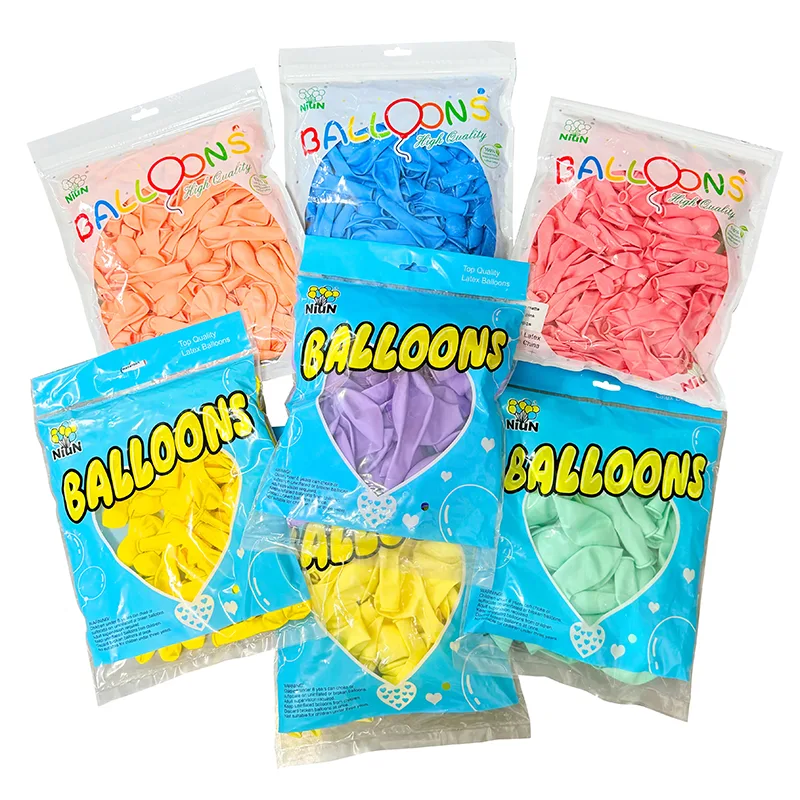
Borun Balloon Factory, operated by Xiongxian Borun Latex Products Co., Ltd., manufactures NiuN® latex balloons from pure natural latex in Hebei, China. Material origin, color consistency and standard toy-safety testing must not be presented as evidence that the finished balloons are harmless to wild animals.
How Balloon Debris Reaches Wildlife
The principal distinction is between a balloon being used in a controlled display and balloon material entering the wider environment. The pathway matters because the hazard arises after a whole balloon, fragment or attachment becomes accessible to animals.
Helium-filled latex balloons may escape during distribution or an event. Air-filled balloons, unused pieces, popped fragments and detached ribbons can also become litter if they are left behind.
Balloon material may enter trees, shorelines, wetlands, waterways or other habitats. The manufacturer, retailer and event organizer cannot determine where a deliberately released balloon will eventually land.
Birds, turtles and other animals may ingest balloon debris. Strings and ribbons can become entangled around animals. Ingestion and entanglement may cause injury or death.
Prevent intentional release, reduce opportunities for escape, control loose materials, provide supervised installation, and collect used decorations. Avoid balloons where a suitable containment and cleanup plan cannot be established.
The U.S. Fish and Wildlife Service has described balloon ingestion and entanglement involving birds, turtles and other animals. The National Oceanic and Atmospheric Administration explains that released balloons can eventually fall back to land or water and become marine debris. These are documented hazards, not laboratory findings specific to one Borun balloon model.
Why Pure Natural Latex Does Not Prove Wildlife Safety
Pure natural latex describes the material used for Borun's latex balloons. It does not establish that a finished balloon disappears harmlessly after outdoor release. The balloon's formulation, processing, surface treatments, printed artwork and the actual environment can affect what happens after disposal.
A 2021 study published in the Journal of Hazardous Materials examined latex balloon degradation over 16 weeks in freshwater, saltwater and industrial compost. The tested balloons retained their original shape and size, and did not show meaningful complete degradation during the study period. These findings should not be converted into a fixed degradation period for any specific Borun balloon.
Important distinction: A laboratory investigation into the fate of balloon material does not measure how often animals encounter a particular retail balloon. Conversely, a safety test report for a latex balloon does not certify harmlessness to wildlife. No model-specific wildlife-safe test outcome is claimed here.
Importers should therefore reject the argument that biodegradable material makes balloon releases acceptable. A balloon or ribbon can harm an animal before any meaningful degradation occurs.
Specify the Actual Latex Balloons in the Wholesale Order
Borun's wholesale latex balloon range includes several nominal sizes and gram-weight grades. Those fields identify the exact physical product being purchased. They do not rank one size as safer for wildlife than another.
| Nominal size | Confirmed weight grade | Possible supply application | Buyer control to specify |
|---|---|---|---|
| 5 inches | 1.1 g | Garland details and mixed-size packs | Loose-piece control and fragment recovery |
| 10 inches | 1.5 / 1.8 / 2.2 g | Party decoration and retail assortments | Issued quantities and event removal |
| 12 inches | 2.8 / 3.2 g | Garlands, promotional displays and retail packs | Installation method, supervision and collection |
| 18 inches | 9.5 g | Large accents and controlled displays | Site suitability and secure removal |
| 36 inches | 35 g | Large-format event decoration | Handling plan, installation and clearance |
Matte, metallic, macaron, pearl and retro finishes provide different decorative appearances. A different finish or a higher gram weight is not proof of lower wildlife risk. Purchase specifications should include the selected size, gram-weight grade, color, finish, pieces per pack and intended application.
Choose Event Applications Based on Containment
Buyers should review the actual venue before approving a latex balloon supply plan. The table below describes operating decisions, not measured risk ratings or legal permissions. Local venue restrictions and applicable laws must also be checked.
A controlled display may be considered where setup, monitoring and complete removal responsibilities are clearly assigned. Collect popped balloons and loose packaging promptly.
Review planAssess wind, weather, public access, fastening, available supervision and the ability to remove all accessible decorations. Do not proceed if containment is unreliable.
ConditionalWhere accidental escape could carry balloon material into a habitat or waterway, prioritize decorations that do not rely on balloons.
Prefer alternativesDo not approve the release of latex balloons as an event activity. Propose a celebration format that does not send balloons into the environment.
Reject releaseAir-filled balloon arrangements may reduce reliance on floating helium displays, but air filling alone does not prevent litter. Ribbons, ties and small balloon fragments must still be controlled.
Review Your Wholesale Latex Balloon Application
Send Borun the exact balloon sizes, weight grades, finishes, colors, quantity, retail packaging needs and intended use. Include the event location type and relevant installation or handling requirements when discussing your order.
Write Responsibility into the Event-Supply Instructions
A general statement such as "use balloons responsibly" does not tell an event team what to do. A useful event-supply instruction separates preparation, display and removal responsibilities.
- Before setup
- Identify the venue, balloon configuration, number of balloons issued, installation supervisor, loose accessories, waste containers and cleanup personnel. Confirm that no balloon release is planned.
- During preparation
- Keep uninflated latex balloons, unused pieces and ribbons under control. Collect damaged or popped balloons as they occur. Avoid leaving loose fragments near open doors, drains or outdoor escape routes.
- During display
- Monitor accessible decorations and attachment points. Where weather, attendance or venue conditions undermine containment, remove the affected display.
- At closing
- Remove the latex balloons and attached materials. Record whole balloons retrieved, known bursts, observed missing items and debris collection. Follow the appropriate local waste instructions.
- If material escapes
- Document the incident, recover accessible material where safe, and escalate unresolved losses to the venue manager when appropriate. Do not put staff at risk to retrieve inaccessible balloons.
How a Buyer Can Reconcile an Event Balloon Order
Counting the balloons before and after an event can improve accountability, but a burst balloon may become several fragments. A count of debris pieces is not equivalent to a count of complete balloons.
Consider this hypothetical operating example. It illustrates an event-supply record and does not describe an actual Borun order.
Even though the numerical record reconciles 120 original balloon units, it does not demonstrate a complete environmental recovery. The two missing balloons are unresolved, and fragment recovery has not been independently verified. This is why a procurement closeout must distinguish accounting for product units from recovering all environmental debris.
Practical improvement: Require event suppliers to report known releases, missing balloons, ribbon losses and incomplete cleanup separately. Do not claim a 100% recovery rate merely because the original order quantity can be reconciled on paper.
Check Wildlife Claims and Retail-Pack Instructions
Retail distributors and private-label buyers should review the actual sentence proposed for the package. The material description of a balloon and the environmental outcome implied by a marketing claim are not equivalent.
Do not approve. There is no verified Borun product-specific evidence supporting an unrestricted wildlife-harmlessness claim. A compliant manufacturing specification does not establish this outcome.
Do not approve. The source material does not establish that an animal cannot ingest the balloon or become entangled in attached material.
Do not approve without adequate, claim-specific evidence. Any degradation statement must identify the tested finished article, relevant conditions and limits of the claim. A general material fact is not sufficient.
Factual material description when it matches the approved product specification. Do not imply that the material statement certifies wildlife safety, recyclability or compostability.
Appropriate proposed responsible-use wording, subject to the buyer's packaging review and destination-market requirements. Other required warnings must be considered separately.
The U.S. Federal Trade Commission's Green Guides caution against broad, unsubstantiated environmental marketing claims. Importers also need to consider the rules of the actual destination market and approved package language.
Borun can coordinate customized balloon retail packaging through its long-term affiliated packaging manufacturing partner. The buyer should approve any handling instructions, warnings, translations and artwork before the packaging is ordered or produced. This coordinated service does not mean that Borun manufactures the packaging in-house.
When Does a Wholesale Latex Balloon Order Make Sense?
A wholesale latex balloon order is not an acceptable substitute for a release-prevention plan. Before purchasing, an importer or event company should confirm that the intended use can be managed and the necessary product information is available.
Borun's standard latex balloon minimum order quantity is 5,000 pieces. Common nominal sizes are 5, 10, 12, 18 and 36 inches. Samples generally require 3–5 working days, and normal production is typically 5–15 working days after the relevant specifications and approvals are complete. These are purchasing references, not promises about wildlife exposure.
For relevant custom printed latex balloon orders, the standard minimum is 5,000 pieces per design. Up to five print colors are supported, with feasible print positions assessed for the artwork and selected balloon. Printed artwork does not establish an environmental safety benefit.
Send Your Latex Balloon Wholesale Requirements to Borun
Specify the latex balloon size and gram-weight grade, finish, approved color assortment, quantity, packaging, printing if needed, destination market and intended event application. Include proposed responsible-use wording for packaging review.
Frequently Asked Questions
Are latex balloons safe for wildlife if they are biodegradable?
No. A biodegradation description does not demonstrate that a released balloon cannot be ingested by wildlife or cause entanglement. Do not release balloons into the environment.
Do higher-quality latex balloons prevent wildlife harm?
Not when a balloon is released or discarded outdoors. Product consistency is important for a wholesale order, but it does not remove ingestion or entanglement risks from environmental litter.
Are air-filled latex balloon arches acceptable outdoors?
A secured, supervised installation may be considered where the venue and conditions allow reliable management and removal. Air filling alone is not a guarantee against escape or litter. Choose balloon-free decoration if containment is unreliable.
Do balloon weights eliminate the risk of accidental release?
No. A weight or attachment can fail or become detached. A responsible installation requires monitoring, prompt correction and a removal plan.
What should a balloon supplier's cleanup instructions include?
Instructions should address release prevention, control of unused balloons, retrieval of accessible fragments, ribbons and ties, and post-event waste handling. A responsible person should be identified for the event.
Can CE, EN 71 or CPC documentation prove wildlife safety?
No. These documents have specific safety and regulatory purposes. They do not certify that latex balloons or attached accessories are harmless to wildlife.
Can wholesale latex balloon packaging include a no-release instruction?
A proposed instruction such as "Do not release balloons. Collect after use" can be reviewed for an appropriate retail pack. The buyer should also check the destination market's required product warnings, languages and labeling rules.
Evidence statement: the wildlife risks discussed here are based on published environmental guidance and research. The example event reconciliation is hypothetical. This article does not claim that any Borun latex balloon has undergone a product-specific wildlife safety test, nor does it certify harmless degradation, complete event recovery or zero environmental risk.