2026 U.S. Balloon Import Entry Preparation
CPSC eFiling is now in effect for most imported consumer products requiring a U.S. Consumer Product Safety Commission certificate. For wholesale balloon importers, the immediate task is to match the correct product certificate information with the goods and the customs entry.
Since July 8, 2026, covered importers have been required to electronically file certificate data. Incorrect or missing information can create compliance questions, inspections and delays. eFiling does not guarantee clearance, and an electronic filing error does not automatically mean customs seizure.
Quick Reference: CPSC eFiling for Wholesale Balloon Imports
The rule concerns products subject to CPSC certification requirements. A balloon's material alone does not decide whether a Children's Product Certificate (CPC), General Certificate of Conformity (GCC), or another regulatory treatment is appropriate. The U.S. importer must determine the applicable product requirements.
Match the Balloon Product Before Preparing eFiling Data
Borun Balloon Factory manufactures latex balloons for wholesale import orders in sizes from 5 to 36 inches. Importers should identify the exact size, color, finish, approved specification and packaging before assigning the certificate's product identifier.
Borun also supplies foil balloons for wholesale purchasing, including distinct styles, sizes and printed designs. Foil balloons must not be matched automatically to testing records for latex balloons.
For balloon arch garland kits, identify the complete set and its components. Testing evidence supporting the latex balloon components does not, by itself, establish compliance for additional accessories or the entire assembled set.
The Seven Certificate Data Fields to Check
Before the customs entry is filed, compare the product certificate information with the importer-approved balloon order and available manufacturing and testing records.
| Required Field | What to Verify | Where to Check |
|---|---|---|
| Product ID | Correct identifier for the certified balloon product | Product certificate, order and item records |
| Citation Codes | Applicable U.S. product safety rules | Importer certification review |
| Manufacture Date | Manufacturing date covered by the certificate | Relevant production records |
| Manufacture Place | Correct manufacturer, location and contact details | Confirmed factory information |
| Product Test Date | Most recent applicable compliance testing date | Supporting test evidence |
| Testing Laboratory | Laboratory details associated with applicable tests | Test records and certificate |
| Records Contact | Person or organization maintaining test records | Certificate recordkeeping details |
If the importer relies on component testing or a permitted testing exclusion, the certification records must reflect the applicable requirements. Test report identifiers may also be useful, but they are not a substitute for the required certificate fields.
Confirm Borun Balloon Product Information Before Entry Filing
Send Borun your balloon product category, approved variant, order quantity and U.S. destination. Ask for the relevant manufacturing and available test information needed to prepare your importer's certification records.
Request Balloon Manufacturing InformationFull vs. Reference eFiling: Which Record Does Your Broker Need?
Full PGA Message Set
The importer supplies the seven required product certificate data elements to its customs broker or authorized filer for transmission through CBP's Automated Commercial Environment.
Reference PGA Message Set
The importer first stores the certificate information in the CPSC Product Registry. Its filer then submits the Certifier ID, Product ID and Version ID to reference that stored certificate.
The CPSC Product Registry is not mandatory for Full PGA filing. Reference filing can help with repeat imports when the stored certificate continues to describe the same certified balloon product.
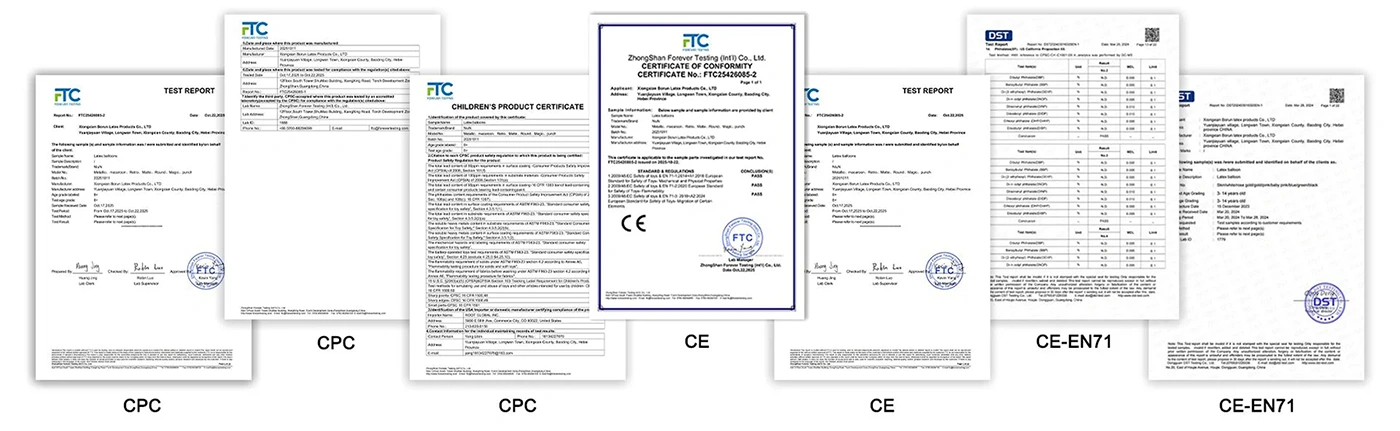
Check Filing Errors Before the Balloon Shipment Enters U.S. Customs
| Potential Problem | Practical Check | Who Should Resolve It? |
|---|---|---|
| Wrong product identifier | Compare certified balloon ID with the actual imported variant | Importer and product-record holder |
| Incorrect factory information | Match manufacturer details to reliable production records | Importer with factory support |
| Testing information mismatch | Review applicable test dates, rules and laboratories | Importer and certification specialist |
| Wrong Reference identifiers | Confirm Certifier ID, Product ID and Version ID | Importer and customs filer |
| Tariff classification concern | Confirm the appropriate U.S. customs classification separately | Importer and customs broker |
Do not confuse certificate data with customs classification. Harmonized Tariff Schedule codes are important to the customs entry, but they are not one of the seven core CPSC certificate fields. Your customs broker should verify the classification for the actual balloon product.
CPSC currently states that it does not intend to request entry denial solely for failure to eFile certificate information, and that initial missing-data responses are generally warnings rather than automatic rejections. This does not remove the obligation to certify applicable products or prevent enforcement against noncompliant goods.
Prepare Your Wholesale Balloon Order and Filing Records Together
Before confirming production and shipment, share the exact latex balloon, foil balloon or balloon arch garland kit configuration with Borun. Confirm available supporting documents, production information and packaging details, then coordinate certificate filing with your U.S. importer and customs broker.
Contact Borun for Wholesale Balloon SupplyCPSC eFiling Questions for U.S. Balloon Importers
Does eFiling require uploading every laboratory test report?
No. The filing transmits required certificate data. Test reports must support certification and may need to be provided for review, but full laboratory report files are not automatically one of the seven required certificate fields.
Must every foil, latex or Bobo balloon use a CPC?
Not automatically. The applicable certificate and test requirements depend on the specific product, its intended use and the relevant U.S. safety rules. The U.S. importer should make this determination for each imported configuration.
Can Borun guarantee that accurate eFiling prevents customs seizure?
No. Accurate certificate data reduces avoidable filing discrepancies, but it does not guarantee clearance. CBP and CPSC retain their enforcement authority, and the importer remains responsible for applicable certification and entry obligations.
Bottom line: Identify the actual balloon, verify its required certificate information, choose the correct filing method, and resolve discrepancies before customs entry. Reliable factory records support the process; they do not replace the U.S. importer's legal responsibilities.