Sourcing wholesale foil balloons from China requires agreement on the actual balloons, the contracting seller, the export and import responsibilities, destination-market documents and the point at which delivery is complete. After a China foil balloon manufacturer confirms the product specification, buyers should select a suitable trade term with a named place, establish the required document set and plan backward from the date the wholesale balloons must reach their warehouse.
The same factory quotation can lead to very different landed purchasing costs under Ex Works, Cost Insurance and Freight, Delivered at Place or Delivered Duty Paid. A procurement team should compare those terms by their responsibilities and risk-transfer points, not by the impression that every quotation covers door-to-door delivery.
2026 China factory sourcing guide for foil balloon importers, international wholesalers, party-supply distributors and private-label procurement managers.
Quick Reference: Four Decisions Before Importing Foil Balloons from China
For context, Borun Balloon Factory manufactures standard and custom foil balloons in Xiongxian, Hebei, China, under Xiongxian Borun Latex Products Co., Ltd. and the NiuN® brand. Manufacturing began in 2006. Its published factory structure includes three foil balloon production and customization lines within a wider 15-line balloon manufacturing operation.
Standard stock foil balloons generally start at 100 pieces per exact style, size and color. Custom printed foil balloons start at 5,000 pieces per design, while new custom shapes require a separate development review. These figures help confirm the order basis; the purpose of this guide is to manage the cross-border purchase after that basis has been defined.
1. How Does a Wholesale Foil Balloon Order Move from a Chinese Factory to the Importer?
A foil balloon purchase has several handoff points. Each handoff should leave a record that identifies who must complete the next action. This is especially important when the buyer, Chinese manufacturer, freight forwarder and destination importer are different businesses.
Identify the foil balloon styles, sizes, colors, quantities, approved artwork where applicable, packaging and importing country. Match every physical variant to the purchase order.
Confirm which legal entity sells the foil balloons, the payment conditions, the Incoterms 2020 rule, its named location and the party responsible for each transport and clearance task.
Approve relevant foil balloon samples, artwork and packaging before the manufacturer confirms the bulk production schedule.
Verify carton counts, goods descriptions, commercial invoice details, packing list information, applicable product documents and transport booking arrangements.
Confirm the responsible customs party, transport documents, arrival notices, destination charges and the receiving process at the named delivery location.
Product selection and general supplier screening are separate purchasing decisions. This China factory sourcing guide concentrates on the export-to-import execution chain and the documents that make the chain traceable.
2. Identify the Seller, Exporter and Importer Before the First Payment
A factory name, commercial brand and legal contracting entity do not necessarily mean the same thing. The invoice should identify the business issuing the sale, while customs and shipping records should reflect the businesses responsible for the corresponding export or import activity.
Manufacturer and contracting seller
For a Borun wholesale foil balloon order, identify Xiongxian Borun Latex Products Co., Ltd. as the current manufacturing legal entity where applicable. Confirm that the seller named in the signed purchase documents is the party actually offering the order. Any different contracting or invoicing entity must be explicitly explained and verified.
Exporter and shipment arranger
Ask which entity will complete export customs formalities and which business arranges the transport booking under the agreed trade term. The manufacturer, contractual exporter and freight forwarder may perform different functions; do not assume their identities are interchangeable.
Importer and customs representative
Identify the importer recognized under the destination country's customs system, the appointed customs broker where relevant, and the party responsible for duties, taxes and required import permits. An importer of record is a legal role, not simply the address that receives the goods.
Before sending a deposit: reconcile the legal seller's name, contractual bank details, pro forma invoice, delivery agreement and purchase-order reference. If the commercial invoice will later be issued by a different entity, obtain a documented explanation before proceeding.
3. Compare EXW, CIF, DAP and DDP for Wholesale Foil Balloons from China
Borun lists Ex Works, Cost Insurance and Freight, Delivered at Place and Delivered Duty Paid as trade terms that may be discussed for applicable orders. They are not interchangeable price packages. Specify the correct named place or port and use the Incoterms 2020 version in the purchase agreement.
| Trade term | Delivery and transport scope | Import clearance | What the foil balloon buyer must verify |
|---|---|---|---|
| EXW — Ex Works | Seller makes goods available at the agreed premises; buyer ordinarily arranges collection, export handling and onward transport. | Buyer | Whether the buyer can lawfully and practically arrange Chinese export clearance; consider another term if this is not workable. |
| CIF — Cost, Insurance and Freight | Seller arranges sea carriage and minimum required cargo insurance to the named destination port. Risk generally transfers when goods are on board the vessel at the origin port. | Buyer | Named port, vessel-shipment risk point, insurance coverage, destination charges and import handling. CIF is a waterway-only rule. |
| DAP — Delivered at Place | Seller arranges transport to the named destination, with goods ready for unloading; risk transfers at that delivery point under the rule. | Buyer | Who completes import clearance, pays import duties and taxes, coordinates customs release and unloads the arriving vehicle. |
| DDP — Delivered Duty Paid | Seller undertakes delivery to the named destination and is responsible for export and import formalities, including applicable duties and taxes. | Seller, if legally able | Whether the seller can legally fulfill importer and tax obligations in the destination country; confirm the named address and unloading responsibilities. |
Risk and freight are different: under CIF, a seller paying freight and obtaining required insurance to the destination port does not mean the seller retains cargo risk all the way to that port. Under DAP, the buyer normally handles import clearance. Under DDP, the seller cannot responsibly promise import clearance where destination-country rules prevent the seller from performing that obligation.
The applicable contract, actual route, customs rules and professional logistics advice must be reviewed before any term is selected.
For an importer comparing wholesale foil balloon factory quotations, the most useful instruction is: “Quote the identified foil balloon variants under Incoterms 2020 DAP to the named delivery address, with import clearance and duties excluded.” Such wording communicates a defined responsibility split instead of the ambiguous request “shipping included.”
Confirm the Export and Delivery Scope for Your Foil Balloon Order
Send Borun the exact foil balloon type, quantity, destination country, intended port or delivery address and preferred trade term. Ask which manufacturing, packing and shipment arrangements can be confirmed before the quotation is accepted.
4. Reconcile the Purchase Order, Invoice and Packing List
Customs and warehouse problems often begin with descriptions that no longer match the goods. A pro forma invoice used during negotiation is not automatically a substitute for the final commercial invoice or every other document required for import clearance.
| Document | Purpose in the foil balloon order | Buyer cross-check |
|---|---|---|
| Purchase order / signed agreement | Defines the ordered foil balloons, commercial obligations, trade term and approval conditions. | Correct parties, variant quantities, currency, payment, delivery place and specifications. |
| Pro forma invoice | Supports preliminary commercial confirmation and payment arrangements. | Consistent seller identity, agreed product and payment information; distinguish from final shipping documents. |
| Commercial invoice | Records the goods sold and declared commercial transaction for shipment and customs review. | Seller, buyer, detailed foil balloon descriptions, quantities, prices, currency, terms and origin information where required. |
| Packing list | Identifies packages and their contents for transport and receiving. | Cartons, package markings, quantities by variant, net and gross weights, and measurements where required. |
| Transport document | Records the carriage arrangement, depending on the transport mode. | Consignee, shipment reference, origin, destination, packages and release requirements on the relevant bill of lading or air waybill. |
| Product and origin documents | Support applicable product safety, customs origin or importing-market requirements. | Correct product coverage, responsible issuer, document validity and destination requirements; not every document is mandatory for every shipment. |
A purchase order might list 100 gold number foil balloons and 100 silver number foil balloons. If the final packing list only describes “200 party balloons,” the receiving warehouse may lack the detail needed to distinguish the variants. The invoice, packing list and actual carton markings should preserve the variant identity required by the transaction.
Detailed product descriptions, customs tariff classification and valuation should be established with the responsible customs professional for the importing market. This guide does not assign a universal tariff code or duty rate to every foil balloon.
5. Verify the Destination-Market Documents Before Shipment
The country receiving the wholesale foil balloons determines which product safety, labeling, language and import obligations apply. A CE marking, an EN71 test report and a United States Children's Product Certificate are not interchangeable documents.
European Union destination
Determine whether the imported foil balloon configuration is legally classified as a toy and which current toy-safety and other product rules apply. Where applicable, review CE marking, relevant EN71 test reports, the European Union Declaration of Conformity and importer identification or labeling obligations. Document applicability must be assessed against the actual product and responsible economic operator.
United States destination
Determine whether the foil balloon falls within the applicable children's product safety requirements and which third-party test reports support those requirements. For children's products manufactured overseas, the United States importer is responsible for issuing the Children's Product Certificate when required. A Chinese factory's test report alone does not transfer that responsibility.
Other destination markets
Identify the relevant local classification, labeling, age warnings, chemical or toy-safety requirements, importer details and required commercial documents. Do not assume that compliance documents used for another country automatically qualify the shipment.
Borun publishes CE, EN71-1/2/3/12, CPC-related and European Union Declaration of Conformity documentation for applicable balloon programs. Import buyers should request the documents relevant to the exact foil balloon style, material, intended market and legal classification. A document listing another material or product family cannot be treated as proof for the current shipment without confirming its coverage.
2026 compliance checkpoint: confirm the rules in force when the goods are placed on the destination market. Requirements and transitional arrangements may change; a historical compliance summary should not replace a current product- and market-specific review.
6. Confirm Packaging, Carton Evidence and the Finished Import Unit
Foil balloon export orders are packed as physical units, bags, retail packages or sets. These are different counting levels. A wholesale buyer should approve the product inside the package and then confirm how the packaged units are represented on the packing list.
For standard party foil balloons, Borun's established wholesale baseline is 100 pieces per exact style, size and color, normally organized as two 50-piece bags of the same variant. Custom packaging may change the finished selling unit and carton configuration, so customized packaging requirements must be approved separately.
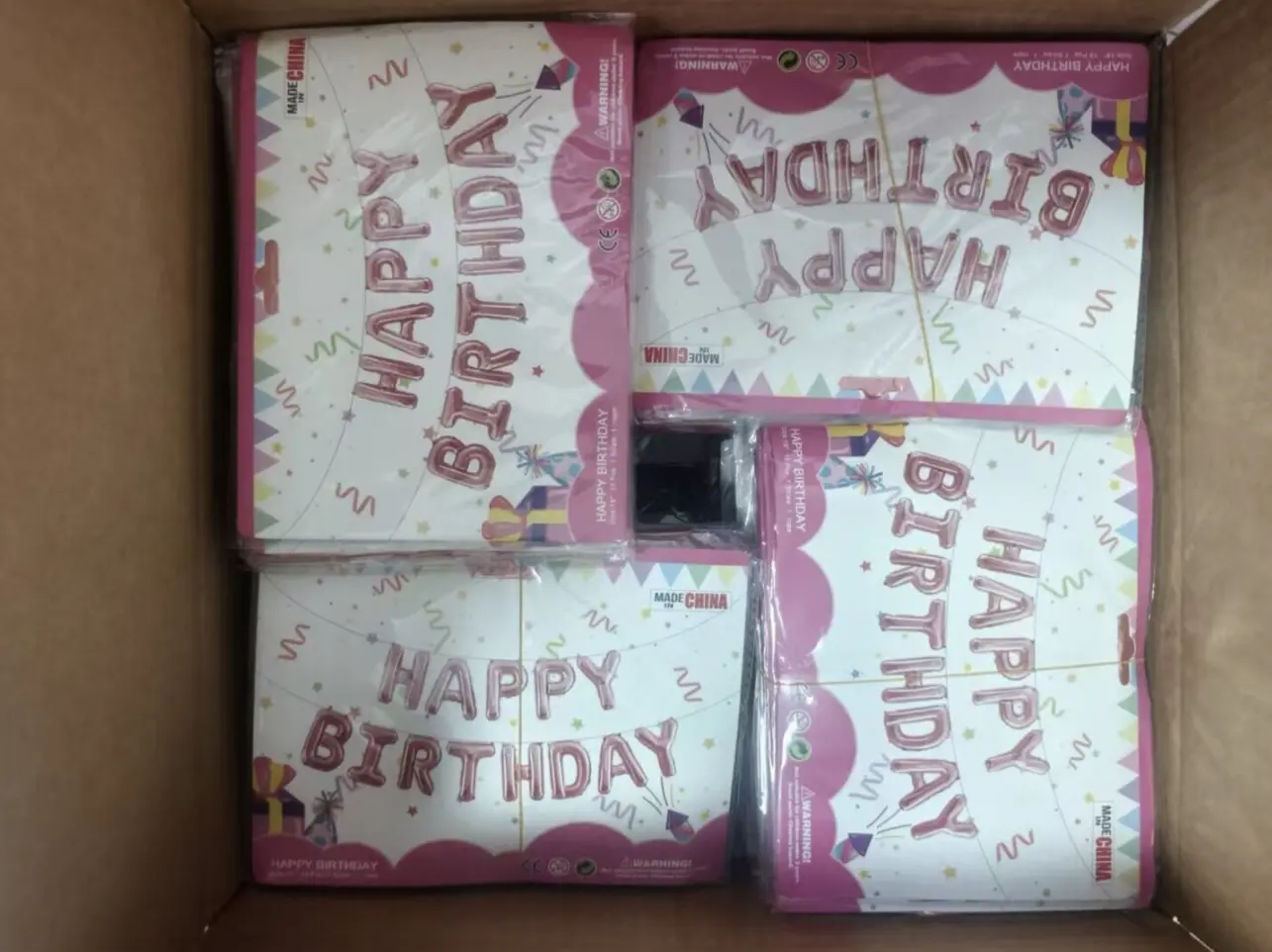
Match the Physical Pack to the Shipping Record
Check the foil balloon product description, pieces per selling pack, quantity by color or style, carton label, outer carton count and any buyer-approved private-label graphics.
For retail-ready or private-label programs, Borun coordinates customized balloon packaging services through a long-term affiliated packaging manufacturer. The balloon factory should not be described as the direct manufacturer of every customized retail package.
The packing photograph supports identification of packaged merchandise. Final carton weights, measurements and packing-list totals must come from the actual order.
When packed foil balloons, loose bulk balloons and accessory-containing sets appear on the same purchase order, ask for separate lines identifying their commercial units. This prevents the invoice and warehouse receiving report from comparing incompatible units.
7. Plan the Shipment Backward from the Importer's Warehouse Date
A production lead time is only one part of an international delivery schedule. For Borun's applicable foil balloon programs, typical bulk production is 5–15 working days after necessary product, artwork and sample approvals. Custom printed foil balloon physical samples may require approximately 3–10 days. These periods are not a guaranteed time from first inquiry to final warehouse receipt.
Product confirmation, artwork or sample approval, contract and payment requirements, packaging and export-document planning.
Scheduled manufacture, finished-goods acceptance, packing totals, commercial invoice, shipping documents and transport booking.
Transit, destination arrival, import clearance, local delivery appointment, unloading and warehouse receiving.
A buyer needing stock in a distribution center by a certain date should ask for the estimated dates of factory completion, cargo collection, international departure, destination arrival and local delivery separately. Transport transit times, port congestion and customs release periods are not interchangeable with factory manufacturing time.
Practical date calculation: start with the required warehouse receiving date, then work backward through destination clearance and local transport, main carriage, Chinese dispatch and completed production approvals. Do not invent a universal “six weeks from China” promise without an actual route and shipment quotation.
8. Release a China Foil Balloon Shipment Only After the Handoffs Match
Before the shipment is released, the importer and manufacturer should have a common record of the approved foil balloon configuration, the paying and contracting parties, the document responsibilities and the agreed delivery location.
- Product release: the finished foil balloons match the approved variant, packing and quality requirements for the specific purchase order.
- Commercial release: the invoice amount, payment stage, named seller and agreed Incoterms 2020 responsibility match the contract.
- Document release: the commercial invoice, packing list and applicable product documents accurately describe the shipment.
- Logistics release: the exporter, freight arranger, importer and customs representative understand their assigned tasks, transport milestones and document handoff.
- Delivery and receiving: the warehouse verifies the delivered cartons and saleable variants against the expected shipment, recording discrepancies under the agreed claims procedure.
Borun's general payment arrangement is a 30% deposit followed by payment of the remaining balance before shipment, subject to the agreed commercial documents. The purchase agreement should identify what counts as an approved production specification and which records must be available before shipment release. A request for different payment terms should be confirmed rather than assumed.
Request a China Factory Wholesale Foil Balloon Delivery Quotation
Send Borun the exact foil balloon variants, quantity per variant, packaging needs, destination country, named port or warehouse address, required receiving date and preferred trade term. Include custom artwork or special shape requirements only if the order calls for them.
Contact Borun for Foil Balloon Export SupplyFrequently Asked Questions About Importing Foil Balloons from China
Can a China foil balloon manufacturer quote delivered pricing?
Yes, where the seller and transport partners can support the proposed destination and responsibilities. Request a named delivery place and the applicable Incoterms 2020 rule; do not use “delivered price” without defining customs, tax and unloading obligations.
Does CIF include customs clearance at the destination?
No. Under the standard CIF rule, the seller arranges specified freight and insurance to the named destination port, but the buyer ordinarily completes import clearance and pays applicable destination import charges. CIF also has a risk-transfer point when goods are loaded on board the vessel at origin.
Is DDP available for every foil balloon shipment?
No. Delivered Duty Paid requires the seller to fulfill import-clearance and duty responsibilities. Some destination countries restrict the ability of a foreign seller to perform those tasks. The actual country, contracting structure and logistics provider must be reviewed before a DDP quotation is accepted.
Which documents should a wholesale foil balloon importer request?
Confirm the purchase agreement, final commercial invoice, packing list, transport document and product- or origin-related documents required for the destination and shipment. The exact set depends on the product classification, transport mode and importing-country rules.
Is a Chinese factory's CPC enough for United States toy imports?
For overseas-manufactured products subject to Children's Product Certificate requirements, the United States importer is responsible for issuing the certificate based on the applicable supporting test results. The importer must confirm the legal product classification and relevant requirements.
Does the 5–15 working-day production time include ocean freight?
No. Borun's typical production period refers to the applicable manufacturing period after approval. Export handling, international transit, customs release and local warehouse delivery require separate scheduling.
Can standard and custom printed foil balloons ship together?
They may be consolidated when commercially and logistically feasible. Each balloon variant or printed design must meet its own applicable production conditions, and all shipment quantities and packages must be identified correctly on the final documents.
2026 sourcing conclusion: importing wholesale foil balloons from a China manufacturer requires one consistent chain of product approvals, contracting parties, trade responsibilities, documents and delivery milestones. The strongest factory quotation is not merely the lowest unit price; it is a written supply commitment that the importer can execute, clear through the destination process and verify when the ordered foil balloons arrive.