Screen printing on latex balloons transfers ink through the open areas of a prepared mesh stencil onto the balloon surface. For custom printed latex balloon buyers, the critical production decisions are the artwork version, how the design is separated into print colors, the required placement and the first printed sample that authorizes bulk production.
A logo may contain two print colors, but a computer file alone does not confirm how those colors should meet, overlap or appear on an inflated balloon. The manufacturer must review the artwork together with the actual balloon size, base color, finish and intended print layout.
Technical production guide for branded balloon importers, promotional product distributors, private-label purchasing managers and custom latex balloon print project owners.
1. What Actually Happens When a Latex Balloon Is Screen Printed?
Screen printing begins with approved artwork and a specified latex balloon. A printable design area is prepared as a stencil on a mesh screen. During printing, ink passes through the open mesh areas and reaches the selected portion of the balloon surface; the blocked areas do not transfer that print color.
For a conventional spot-color layout, each independently printed color is prepared as a separate artwork separation. The balloon must be positioned consistently for the approved layout, and the printed ink must be set according to the validated production method before the resulting balloon is evaluated.
Define the Print
Identify the actual logo, its separate print colors and the balloon area where the artwork belongs.
Transfer Each Layer
Prepare the relevant mesh stencil, hold the balloon in the required position and transfer ink through the open design areas.
Review the Result
Check the assembled graphic on the printed latex balloon before authorizing the agreed bulk configuration.
The process is not simply printing on a flat sheet. A latex balloon is a flexible, curved object whose surface changes during inflation. Consequently, the same graphic can look different on the artwork file, the balloon during printing and the finished inflated balloon.
The Physical Balloon Is Part of the Print Specification
Borun Balloon Factory manufactures custom printed balloons made from pure natural latex. Applicable printing projects use a confirmed size, balloon base color and finish, together with the approved graphic and print placement.
Common available latex balloon sizes are 5, 10, 12, 18 and 36 inches. The suitable screen printing layout depends on the chosen size and product configuration. A print layout prepared for a 12-inch balloon should not be automatically assigned to a 5-inch balloon.
The custom printed latex balloon manufacturing program supports one to five printing colors for applicable projects and a typical minimum of 5,000 pieces per approved design.
The actual number and arrangement of printed sides must be approved for the specified balloon and graphic. A maximum capability stated for one product configuration does not automatically apply to every balloon size.
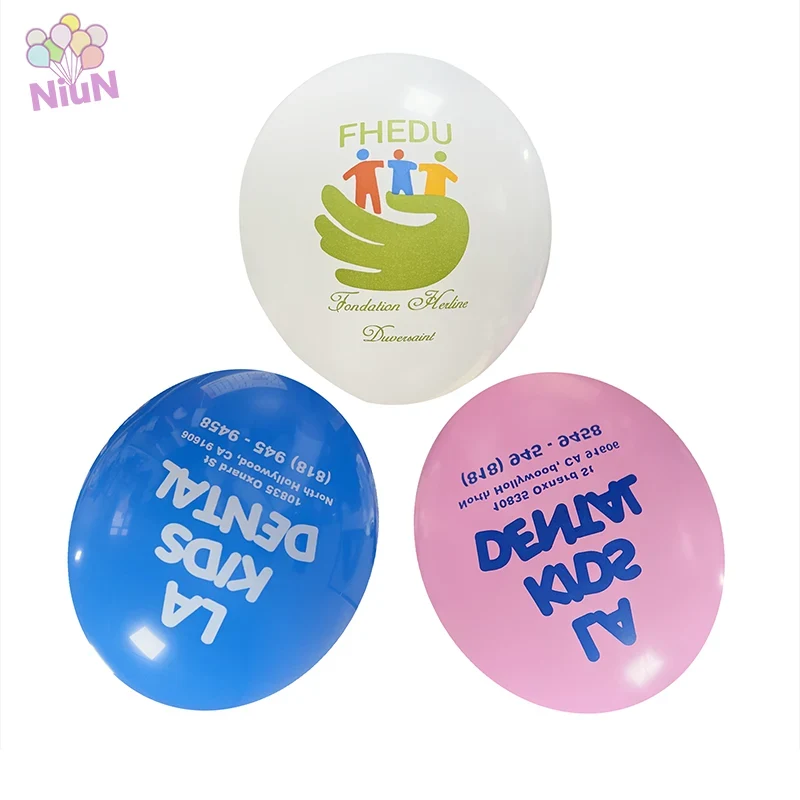
Production interpretation: screen printing describes how ink is transferred through a stencil. The actual mesh specification, ink system, setting conditions and print positioning belong to the factory's verified production configuration. A buyer should not infer those values from an equipment photograph or a generic industry explanation.
2. How Do Separate Screens and Color Layers Affect the Artwork?
A spot-color graphic must be translated from a visual design into printable color areas. This step is called color separation. It explains which portions of the approved artwork are assigned to each print color before the corresponding stencil is prepared.
Consider an illustrative two-color brand graphic printed on a navy-blue latex balloon. The graphic contains a warm-white wordmark and a rose-colored accent. The navy balloon is the base product color, not a third printed ink color. The intended screen printing configuration therefore has two distinct printed color layers for the proposed layout.
Illustrative Two-Color Separation
Warm-white wordmark: identify the exact areas intended to receive the first printed color.
Rose-colored accent: define the second printed color area and its relationship to the wordmark.
Review the assembled two-color design on the proposed navy balloon base.
The buyer must confirm how these print areas relate to each other. If the rose accent touches the white wordmark, the factory may need to review the separation boundary and whether the planned color order or overlap treatment is appropriate. If the logo contains enclosed gaps, those gaps must remain correctly assigned instead of being unintentionally filled by another print layer.
The number of artwork separations is not necessarily the complete number of physical screens required for a multi-position order. Different printed sides, repeated layouts or alternative print placements may require additional setup. The actual screen count and fees therefore belong in the factory's quotation.
Color Separation and Screen Setup Decision Table
| Design condition | What the factory prepares or reviews | Buyer-supplied reference | Required approval decision |
|---|---|---|---|
| One solid printed color | Relevant single-color artwork separation and stencil configuration | Approved artwork revision and intended ink color | Confirm that the printed image contains the correct visible design areas |
| Two defined print colors | Independent color separations, their relative position and suitable print order | Two approved color references and a combined design file | Confirm the assembled graphic on the actual base balloon |
| Adjacent or overlapping color areas | Boundary treatment, print order and possible interaction between the two layers | Enlarged artwork detail and written appearance requirement | Approve the first printed result or request a separation revision |
| Small enclosed detail or lettering | Whether the stencil and actual print can preserve the intended graphic structure | Original editable artwork and intended finished print size | Retain, simplify or revise the required detail based on the physical result |
| Printing on additional sides | Separate positions, orientation and any additional applicable screen setup | Required side layout and viewing direction | Confirm the configuration rather than assuming every side uses the same setup |
These are production-planning decisions rather than a complete printing-color limit tutorial. Borun's applicable latex balloon printing capability extends up to five print colors, but a five-color maximum is not an instruction to use five screens for every logo. Each color and layout must be justified by the actual artwork.
If the buyer selects a matte latex balloon as the printing base, the matte latex balloon product range provides information about the physical base product. That information is separate from the colored ink layers printed over it.
Have Borun Review Your Screen-Printing Color Separations
Send the artwork version, required balloon size, base color, defined print colors, intended printed sides and any touching or overlapping design elements. Request a review of the proposed screen-print configuration before the first physical sample.
3. What Should a Buyer Confirm on the First Screen-Printed Balloon?
After the artwork has been separated and the print configuration prepared, the first printed latex balloon answers a different question from the original graphic file: does the chosen separation and stencil arrangement reproduce the intended assembled design on the selected balloon?
The first-print review should focus on decisions that affect the production configuration. Full print quality inspection, defect sampling and detailed edge-tolerance assessment belong to a separate quality-control procedure.
First-Print Configuration Approval Record
Confirm the exact latex balloon size, base color, finish and applicable product configuration used for the first print.
Identify the approved original design file, date or revision so the sample cannot be confused with an obsolete graphic.
Check whether every visible printed area belongs to the correct artwork separation and intended print color.
Review adjacent-color boundaries, intended gaps, touching elements and overlap areas according to the approved design.
Confirm the required print placement, side arrangement and viewing orientation for this specific balloon.
Compare the printed balloon with the design objective. Check its appearance under the agreed inflation or viewing condition when that condition matters.
Record whether the sample is approved, requires a specific revision or cannot yet authorize bulk printing.
Three Possible Decisions
The first print uses the correct product and artwork version, the color layers correspond to the intended design and the required print arrangement is acceptable.
One or more print areas, layer boundaries, color assignments or layout relationships must change. Update the artwork separation and review the corrected result.
The required first-print result has not been demonstrated, or a critical product, artwork or placement detail remains unresolved. Do not authorize bulk screen printing on the basis of an incomplete reference.
For example, if a two-color graphic shows a rose area where the approved artwork requires white, the first question is whether the color assignment or separation file is wrong. If the file is correct but the assembled sample is inconsistent with the intended overlap, the factory should review the relevant print setup before another sample is approved.
The approved first print establishes the printing configuration used for bulk production. Detailed acceptance of logo edge definition, legibility and finished-product consistency still requires the applicable quality criteria and actual production checks.
4. What Must a Factory Confirm Before Bulk Screen Printing?
A screen-printed latex balloon purchase includes both the physical balloon and its printed configuration. Before ordering wholesale screen-printed latex balloons, the buyer should send enough information for Borun Balloon Factory to confirm the required manufacturing setup, not just the total number of balloons.
Screen-Printed Latex Balloon Factory RFQ Brief
- Physical balloon
- Exact size, pure natural latex product specification, base color, finish and relevant weight grade.
- Artwork
- Current approved logo or artwork file, preferably an editable vector file, with a clear version reference.
- Color separations
- Each defined print color, color reference and any important boundary or overlap treatment.
- Print layout
- Required position, orientation, print size and printed sides, subject to the selected balloon's actual capabilities.
- First-print approval
- Physical sample requirement, the points to be reviewed and the person or team authorized to approve it.
- Wholesale order
- Quantity per approved design, packaging format, destination market and requested production schedule.
- Commercial confirmation
- Actual screen preparation charges, unit pricing, sample conditions, payment and applicable delivery terms.
Borun Balloon Factory, operated by Xiongxian Borun Latex Products Co., Ltd. under the NiuN® brand, manufactures custom printed latex balloons in Xiongxian, Hebei, China. The factory has manufactured balloons since 2006 and supports screen printing and digital printing for suitable custom latex balloon projects.
The standard MOQ for a custom printed latex balloon design is typically 5,000 individual balloons. Bulk production normally requires 5–15 working days after the necessary specifications, artwork and sample approvals have been completed. This is a manufacturing period, not an international shipping guarantee.
How setup costs should be confirmed: a screen-printing quotation should identify the actual applicable stencil or screen preparation charges, the approved print configuration and the quantity being purchased. Do not assume a fixed $3 charge per color or a universal industry plate fee. A design requiring multiple printed positions may have setup requirements beyond its basic ink color count.
Where the finished product requires retail or private-label packaging, Borun can coordinate customized packaging for wholesale balloon orders through its affiliated packaging factory. The packaging service and its costs should remain distinguishable from Borun's latex balloon printing manufacturing work.
Importers should also confirm which applicable CE, EN71 or Children's Product Certificate-related documents support the specific finished printed latex balloon and intended destination market. A claim about the printing ink or base balloon alone does not automatically establish certification for every finished configuration.
Request an Order-Specific Latex Balloon Screen-Printing Quotation
Send Borun the final artwork, separated print colors, balloon size and base color, required print arrangement, quantity per design, sample requirements, packaging and destination country. Ask the factory to confirm the suitable configuration, setup charges and approval schedule.
Frequently Asked Questions About Screen Printing on Latex Balloons
What does a mesh screen do when printing on latex balloons?
The mesh carries a stencil corresponding to a selected print-color area. Ink transfers through the open design regions onto the latex balloon surface while the blocked regions remain unprinted for that layer.
Does each printed color need its own artwork separation?
In conventional spot-color screen printing, independently printed colors are normally prepared as separate artwork separations. The actual physical screen setup also depends on placement, printed sides and the approved production arrangement.
Does a blue balloon with a white logo count as two printed colors?
No, not merely because the balloon itself is blue. If only white ink forms the logo, the blue latex is the base balloon color and white is the one defined print color. Additional ink colors are counted separately.
Can Borun print a logo with more than three colors on latex balloons?
Borun's custom printed latex balloon program supports up to five print colors for suitable configurations. Whether a particular multi-color logo is practical depends on its separations, selected balloon, placement and approved physical sample.
Why must the buyer approve the first printed balloon?
The first printed balloon demonstrates how the approved artwork, color layers and physical balloon work together. It enables the buyer to identify required changes before the same configuration is used in bulk screen printing.
Does a digital proof replace a screen-printed physical sample?
A digital proof can establish wording, color assignments and layout intent. It does not, by itself, demonstrate the transferred ink and combined color layers on the actual latex balloon. Physical approval should be used when the printed result is a material purchasing requirement.
What is the standard wholesale minimum for screen-printed latex balloons?
Borun's applicable custom printed latex balloon program normally starts at 5,000 pieces per design. The final balloon specification, color layout, printed sides and packaging must be confirmed in the order quotation.
Production takeaway: screen printing on latex balloons is a controlled relationship between the mesh stencil, separate print-color areas and the selected balloon surface. A wholesale buyer should approve the actual separation and first-print configuration before purchasing the full production run. The clearest manufacturing instruction is one that links the correct artwork version, print layers, physical sample and commercial order to the same screen-printed latex balloon design.