Wholesale Latex Balloons / Environmental Claim Verification
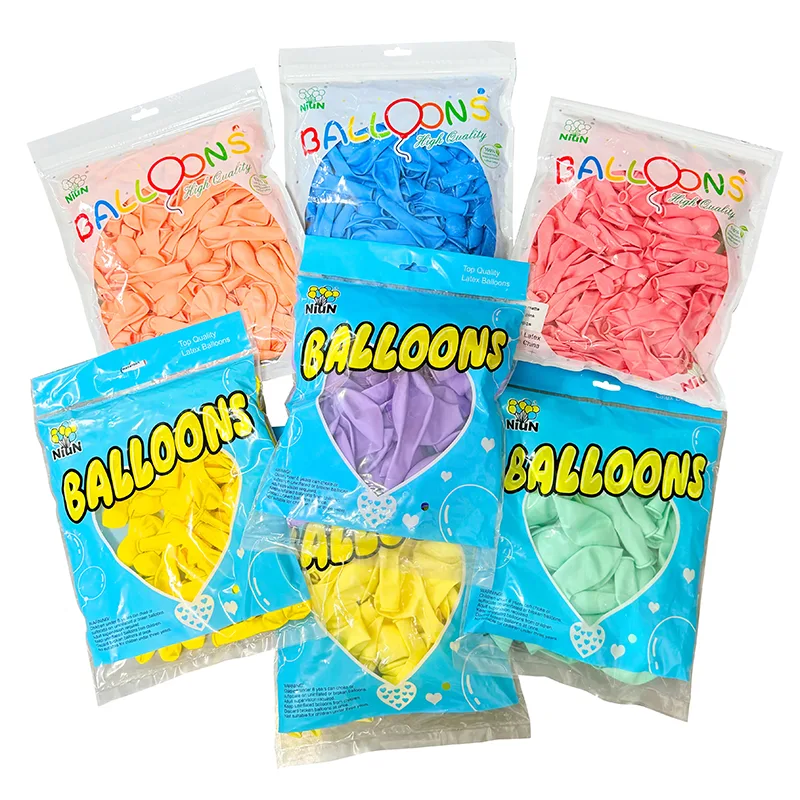
Borun Balloon Factory manufactures wholesale matte latex balloons in buyer-approved sizes and colors from pure natural latex. This material description helps identify the balloon being purchased, but does not establish how quickly the finished latex balloon decomposes.
Importers sourcing wholesale pearl latex balloons for retail distribution should also consider whether the pearlescent finish and any printed artwork are represented in the available environmental testing evidence. A raw-material statement does not automatically cover every finished balloon variant.
Borun Balloon Factory is operated by Xiongxian Borun Latex Products Co., Ltd. in Hebei, China, with balloon manufacturing operations beginning in 2006. NiuN® latex balloons are supplied in standard wholesale configurations. This article does not assert that Borun possesses a verified finished-balloon biodegradation certificate or a measured decomposition time.
Define What “Biodegradable” Claims About the Finished Latex Balloon
Natural latex is obtained from rubber-producing plants. Natural rubber can undergo biological degradation under some conditions. Finished latex balloons, however, are manufactured articles with additional compounding and possible printing materials.
The environmental question is not simply whether the starting polymer comes from a natural source. It is whether the complete finished latex balloon behaves as the proposed marketing claim suggests under its specified disposal conditions.
| Proposed statement | What is actually being claimed | Evidence required | Procurement decision |
|---|---|---|---|
| Made with pure natural latex | Material identity of the specified latex balloon | Actual material specification and representative production information | Use only when the material statement is accurate and supported |
| Biodegradable latex balloon | Environmental performance of the finished balloon | Suitable finished-product test evidence and market-specific claim review | Withhold an unqualified claim without adequate proof |
| Biodegrades in a stated period | Measured decomposition within a particular time | Relevant test duration, endpoint and environmental conditions | Reject unsupported universal timing statements |
| Compostable latex balloon | Suitability for a specified composting process | Appropriate complete-product compostability evidence and access to that process | Do not infer compostability from natural latex content |
| Environmentally friendly printed latex balloon | Broad environmental benefit of the printed article | Evidence for the relevant product-wide impact and the precise claim | Do not approve unqualified promotional wording |
A visible crack, loss of flexibility or smaller balloon fragment is not necessarily proof of complete biodegradation. An appropriate test must measure the relevant biological endpoint. The evidence should represent the exact type of claim being made.
Important limitation: There is no verified Borun finished-latex-balloon biodegradation test result supplied for this article. Therefore, this article does not assign a fixed decomposition period to NiuN latex balloons.
What Independent Research Says About Latex Balloon Degradation
A 2021 peer-reviewed study by Gilmour and Lavers examined commercially available latex balloons in freshwater, saltwater and industrial composting conditions. During the 16-week investigation, the tested balloons retained their recognizable shape and size despite some measured material changes.
The researchers concluded that the tested balloons did not meaningfully degrade over the observed period. This finding challenges broad claims that latex balloons always break down rapidly after release or disposal.
The research did not test Borun's specific NiuN latex balloons, and a 16-week study cannot establish every possible long-term result. Nevertheless, the findings demonstrate why a wholesale buyer should not rely on natural latex content alone when approving environmental marketing statements.
Which Borun Latex Balloon Specifications Must Match the Evidence?
Borun's wholesale latex balloon range includes 5-inch, 10-inch, 12-inch, 18-inch and 36-inch balloons. The approved material, size-specific gram weight, color, surface finish and printed design define the actual commercial article being sourced.
| Nominal latex balloon size | Confirmed gram-weight grades | Commercial description to verify |
|---|---|---|
| 5-inch latex balloons | 1.1 g | Selected matte, macaron or other approved finish and color |
| 10-inch latex balloons | 1.5 / 1.8 / 2.2 g | Selected gram-weight grade, color and wholesale packaging format |
| 12-inch latex balloons | 2.8 / 3.2 g | Exact matte, pearl, retro, macaron or metallic specification |
| 18-inch latex balloons | 9.5 g | Approved finish, color and finished-balloon sample |
| 36-inch latex balloons | 35 g | Approved large-format balloon and packaging specification |
These figures identify physical purchasing specifications, not environmental performance. A heavier latex balloon is not automatically more or less biodegradable than another balloon. The approved product and actual test evidence must be considered together.
Borun supports custom printed latex balloon orders with up to five print colors. Print positions are evaluated for the actual balloon size and approved artwork. The printing chemistry must be considered separately before any environmental claim is extended to the printed balloon.
Evidence Needed Before Approving a Biodegradable Label
A wholesale importer should request evidence specific to the finished latex balloon and the exact environmental claim. A general research article or a toy-safety certificate cannot substitute for product-specific biodegradation evidence.
Identify the Tested Finished Latex Balloon
Record the nominal size, gram-weight grade, color, finish, printing and relevant production reference. Confirm whether these features match the latex balloons being purchased.
Read the Actual Laboratory Method
Verify the laboratory, report number, sampling description, test method and relevant accreditation or technical competence. The method must be suitable for the finished latex balloon and the claimed environmental outcome.
Check the Degradation Endpoint
Distinguish biological degradation measurements from physical fragmentation, visible color changes or simple mass loss. Check the reported endpoint and test controls rather than relying only on a PASS label.
Match Disposal Conditions to the Claim
Review temperature, moisture, microbial conditions, environment and test duration. A controlled compost test cannot automatically establish the same result in an ordinary landfill, freshwater or marine environment.
Check Printing and Retail Packaging Separately
Confirm whether printed inks, specialty surface finishes and packaging are included in the tested article. Do not turn a claim about latex material into a claim about the entire retail package.
Record the Claim Approval Decision
Compare the laboratory evidence with the proposed retail wording and destination market. Keep written evidence of whether the statement is supported, requires qualification or must be removed.
Review Material and Test Evidence for Your Wholesale Latex Balloon Order
Provide the actual latex balloon size, selected gram-weight grade, finish, color, printing, quantity and destination market. Ask Borun which existing material and toy-safety documents can be reviewed, and whether any relevant finished-product environmental evidence is available.
United States, European Union and United Kingdom Claim Rules
Environmental marketing requirements depend on the destination market and the specific statement made to consumers. A wholesale importer should approve the final English or local-language retail claim, not merely the supplier's raw-material description.
United States
The Federal Trade Commission's Green Guides address claims such as biodegradable, degradable and environmentally friendly. An unqualified degradable claim requires strong evidence for the entire article under customary disposal conditions. Landfill disposal and the meaning conveyed to consumers must be considered.
European Union
Directive (EU) 2024/825 strengthens rules against misleading environmental marketing. Member States were required to transpose the Directive by March 27, 2026, with the national measures applying from September 27, 2026. Broad claims such as biodegradable require careful evaluation under the applicable national implementation and claim conditions.
United Kingdom
The Competition and Markets Authority's Green Claims Code emphasizes accurate, clear and substantiated environmental statements. A biodegradable claim should explain material limitations and any special conditions instead of implying that every balloon disappears harmlessly after ordinary disposal.
General toy-safety testing should be evaluated separately. Borun has published latex balloon testing references including EN 71-1, EN 71-2 and EN 71-3 document FTC25426085-2, United States third-party testing report FTC25426085-1, and separate EN 71-12 reference RC2606114455.
The complete reports must be checked for their actual tested samples and relevant scope. Those documents do not establish the biodegradation of finished NiuN latex balloons and should not be used as environmental marketing certification.
Approve Retail Copy Only Within the Supporting Evidence
A buyer should not assume that an environmentally attractive phrase is suitable for retail packaging. The statement must match the facts available for the specific finished latex balloon.
| Proposed retail statement | Evidence position | Buyer disposition |
|---|---|---|
| 12-inch latex balloons made with pure natural latex | Requires accurate material evidence for the approved 12-inch balloon | Review the material wording before use |
| 100% biodegradable 12-inch printed latex balloons | Not established by natural latex content or ordinary toy-safety testing | Do not approve without suitable product-specific substantiation |
| Latex balloons disappear harmlessly after release | Unsupported environmental and wildlife safety implication | Reject the statement; do not promote balloon release |
| Compostable retail latex balloon package | Needs evidence for the actual packaging materials and relevant composting conditions | Assess packaging separately from the balloons |
| Printed latex balloon made using approved artwork and colors | A purchasing specification statement, not a biodegradability claim | Check the actual production approval and final print |
Buyer distinction: Even the factual phrase "made with pure natural latex" should be checked for accuracy, context and the overall impression created by other packaging graphics. It should not be paired with unsupported claims that finished balloons rapidly return to nature.
Build a Product-Specific Purchase and Claim Approval Record
Order the Latex Balloon, Not an Unverified Environmental Promise
Borun's standard wholesale latex balloon minimum order quantity is 5,000 pieces. Physical samples generally require 3–5 working days, while production normally requires 5–15 working days after the relevant specification, sample and artwork approvals.
Borun supports customized printing and can coordinate customized packaging for wholesale latex balloon orders through a long-term affiliated packaging manufacturing partner. Borun is not the packaging manufacturer.
If an importer cannot substantiate a biodegradable statement for the exact finished latex balloon, the importer may still review the balloon's actual material, size, color, finish, packaging and purchase terms without applying an unsupported environmental label.
Approve the Physical Specification
The wholesale latex balloon's material, size, finish, color, printing and packaging are documented and acceptable.
Request More Claim Evidence
The retailer requests biodegradable wording but available laboratory reports do not fully support the actual proposed statement.
Withhold Environmental Labeling
Do not use an unqualified biodegradable or wildlife-safe statement where sufficient evidence is unavailable.
Request a Wholesale Latex Balloon Quote with Clear Material Specifications
Send Borun the required latex balloon size, approved gram-weight grade, finish, color, printing artwork, quantity, destination market and proposed retail packaging statement. Ask which existing product documents can be reviewed. Any environmental claim must be separately substantiated.
Frequently Asked Questions About Biodegradable Wholesale Balloon Claims
Are all pure natural latex balloons certified biodegradable?
No. Pure natural latex identifies a material, not an automatic certification for the finished latex balloon. Buyers need suitable product-specific evidence before making environmental performance claims.
How long do Borun latex balloons take to biodegrade?
A verified decomposition period for the complete finished NiuN latex balloon has not been provided for this article. Environmental conditions and the actual balloon formulation matter. A universal time should not be advertised without evidence.
Can a 12-inch matte latex balloon be labeled biodegradable because it is made with pure natural latex?
Not on that basis alone. The exact 12-inch matte latex balloon, including relevant color and finishing materials, requires appropriate substantiation for the proposed claim.
Does an EN 71 or CPC test report prove latex balloon biodegradability?
No. Relevant EN 71 and United States toy-safety testing addresses specific product safety requirements. Those reports are not substitutes for suitable finished-balloon biodegradation testing.
Can custom printed latex balloons be advertised as fully biodegradable?
Not without evidence covering the actual printed latex balloon and the statement. Do not assume that every printing ink degrades in the same way as the latex base.
Does burying a latex balloon in garden soil prove biodegradability?
No. An informal garden burial demonstration cannot establish the standardized biological degradation endpoint, suitable controls and market-specific evidence required for an environmental claim.
Does biodegradable mean that latex balloons can be released outdoors?
No. Latex balloons and balloon fragments can become litter and threaten wildlife. Buyers and event organizers should not promote releasing latex balloons as an acceptable disposal method.
What should a private-label latex balloon importer submit for a quotation?
Provide the specific latex balloon size, gram-weight grade, finish, color, printing requirements, wholesale quantity, packaging format and destination market. If environmental wording is proposed, supply the exact retail statement for evidence review before approval.
Evidence boundary: this article supports purchasing and environmental claim review of finished wholesale latex balloons. It does not certify NiuN latex balloons as biodegradable, compostable, harmless to wildlife or capable of decomposing within a specific period. Such claims require appropriate, product-matched evidence and destination-market review.