Full-color designs can be printed on suitable latex balloon projects, but gradients, continuous tones, shadows and complex illustrations require an artwork-feasibility review and a physical sample. The supplier must establish whether the intended result can be reproduced on the selected balloon, not merely whether digital printing equipment is available.
For balloon importers, promotional product distributors and private-label brand buyers, the decision is whether the finished printed latex balloon will preserve the visual information the customer actually needs. A digital preview is an important instruction, but it is not evidence that every complex effect will look identical after inflation.
Scope: full-color artwork feasibility and sample approval for wholesale custom printed latex balloons. Photo-specific image preparation and detailed print-method comparisons are separate topics.
Quick Reference — Full-Color Latex Balloon Feasibility
- Suitable artwork for review
- Gradients, continuous tones and complex illustrations, subject to the actual design.
- Printing consideration
- Digital CMYK feasibility review for artwork needing continuous tonal reproduction.
- Approval evidence
- Identified artwork version and a physical sample of the specified latex balloon.
- Standard wholesale MOQ
- 5,000 individual balloons per approved custom printed design.
- Product specification
- Balloon size, base color, finish, artwork scale and proposed print placement.
- Printing sides
- Order-specific review; no universal side-count promise for complex artwork.
1. Can Full-Color Designs Actually Be Printed on Latex Balloons?
Yes, when the actual artwork and printing configuration are suitable. The important distinction is between a design containing several clearly defined solid colors and artwork whose appearance depends on continuous color changes.
A logo with five separate, solid colors is not automatically a full-color printing project. It may be described through five defined color areas. By contrast, a blue-to-pink gradient may contain a wide range of intermediate tones even though the designer describes only two endpoint colors. These artwork types require different production reviews.
Borun Balloon Factory manufactures custom printed latex balloons from pure natural latex. Its applicable custom printing program supports up to five defined print colors, along with artwork review and suitable digital printing configurations. That standard capability is not a promise that every continuous-tone image can be reproduced at every balloon size.
The Printed Latex Balloon Is the Final Test Surface
A latex balloon changes shape as it inflates. The visible scale, proportion and appearance of a printed graphic can therefore differ from the original flat computer artwork.
Base color matters as well. A soft blue gradient intended for a white balloon should not automatically be assumed to have the same appearance on a dark blue balloon. The buyer should approve the result on the exact balloon base being ordered.
For the physical product options, Borun's custom printed latex balloon manufacturing program covers commonly requested sizes of 5, 10, 12, 18 and 36 inches, with selected matte, metallic, macaron, pearl and retro finishes.
The actual print area, full-color result and placement must be reviewed for the individual configuration before bulk production.
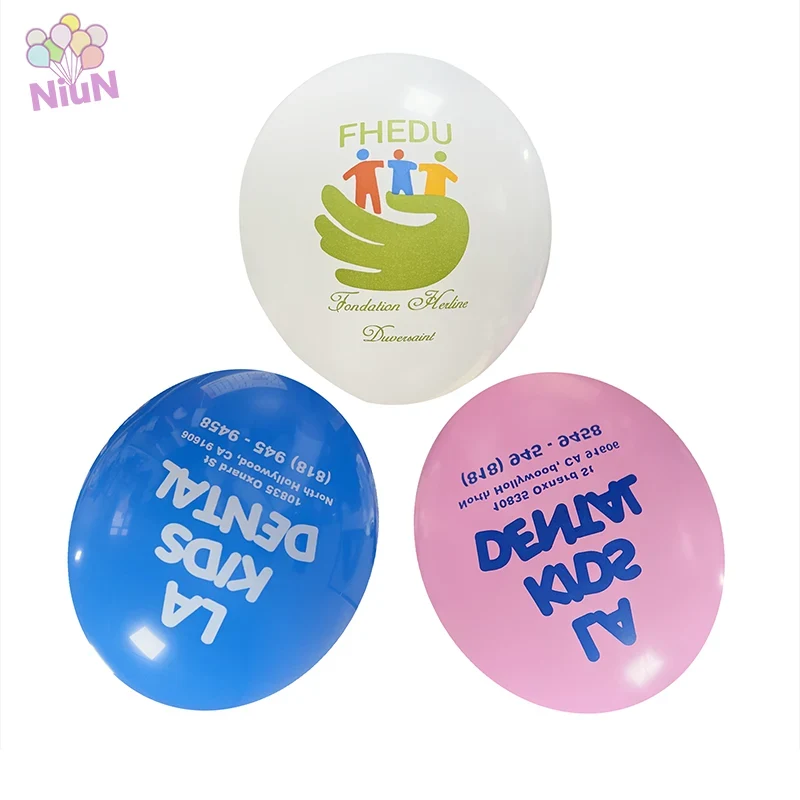
Important distinction: a manufacturer offering digital CMYK printing can review complex artwork, but the term “full color” does not establish unlimited printable detail, exact screen-to-latex color matching or guaranteed reproduction on every balloon finish. Those conditions must be demonstrated by the relevant physical sample.
2. Which Full-Color Artwork Effects Need a Digital CMYK Feasibility Review?
Full-color feasibility depends on the visual structure of the artwork, not simply its apparent number of colors. The following three examples show why a designer's digital file needs to be interpreted before the factory selects a production configuration.
Defined Solid Colors
Separate graphic areas use three specified colors. This is a conventional defined-color design and does not automatically require full-color tonal reproduction.
Continuous Gradient
The intermediate tones form part of the intended design. The buyer must identify which transitions need to remain visually smooth on the inflated balloon.
Shadow and Transparency-Like Effects
The computer preview uses blended or semi-transparent appearance. The factory needs an explicit description of the intended visible print result.
Artwork Feasibility Matrix: Design Feature, Factory Review and Approval Evidence
| Artwork feature | Production review | What the buyer must see on a sample | Decision boundary |
|---|---|---|---|
| Defined solid print colors | Confirm color references and proposed printing configuration | Correct printed colors and assembled graphic on the chosen balloon | Do not classify a solid-color logo as continuous-tone printing by color count alone |
| Smooth gradient | Review digital tonal reproduction on the target balloon and base color | The essential transition remains visually acceptable after inflation | If the transition is not acceptable, revise the artwork or proposed process |
| Continuous-tone illustration | Identify critical intermediate tones and their visible relationships | The intended illustration remains recognizable at its actual printed scale | A monitor preview is not sufficient approval evidence |
| Shadow or transparency effect | Clarify whether the effect is a required printed result or merely a digital presentation effect | Required visual depth and background interaction are acceptable | Do not promise literal digital transparency without physical verification |
| Complex fine detail | Review the necessary size and visibility of text, lines and small graphic elements | Critical information remains identifiable on the inflated balloon | Revise details that cannot be reproduced acceptably |
| Photographic element | Determine whether the design needs separate photo-specific artwork review | The approved image subject and important detail remain recognizable | Photo-specific resolution and portrait requirements are evaluated separately |
This matrix does not presume that each complex artwork effect has already passed Borun's manufacturing approval. It identifies which technical question must be resolved before the buyer can decide whether the submitted design is ready for physical sampling.
For a project using a matte latex balloon base, buyers may also review the wholesale matte latex balloon product specification to select the intended balloon. The matte finish does not, by itself, prove that a particular gradient will reproduce as intended.
Identify the Full-Color Effects Before You Pay for a Sample
Send Borun the current artwork, selected latex balloon size, base color and the gradients, shadows, tones or critical details that must remain recognizable. Ask which effects can proceed to a physical sample and which need clarification first.
Send Full-Color Artwork for Review3. What Must a Full-Color Physical Latex Balloon Sample Prove?
Once the artwork is sufficiently defined, the factory can evaluate the proposed printing configuration and discuss a relevant physical sample. Sample approval should address the actual intended result, not merely the fact that a design has appeared on a balloon.
Physical Sample Evidence: What Changes After Inflation?
Identify the artwork revision, exact balloon size, base color, surface finish and required visual effects. State which design elements are essential to the buyer's brand or retail presentation.
Confirm the printed design identity, obvious artwork omissions, overall placement and the specified balloon product. This condition alone does not establish the final inflated appearance.
Under an agreed inflation and viewing condition, compare the overall graphic, color transitions, significant tonal relationships, text, fine detail and visible proportions against the buyer's intended result.
Identify the accepted sample and artwork revision, any deviations accepted by the buyer and the actual configuration released for bulk production.
Consider an illustrative design with a purple-to-peach background transition behind a small company wordmark. The buyer may find the gradient acceptable but decide that the wordmark is too difficult to read when the balloon is inflated. That is not an automatic rejection of all full-color printing. It is evidence that the particular artwork needs a change in text size, contrast, placement or another reviewed design feature.
Likewise, if the printed sample makes the gradient appear as clearly separated color bands, the buyer should not authorize bulk production merely because the correct endpoint colors are present. If a smooth transition is essential, it must be evaluated as part of the approved physical result.
Three Possible Outcomes
Proceed to Physical Sampling
The artwork, critical effects and latex balloon specification are clear enough for the factory to evaluate a proposed full-color printing configuration.
Revise the Artwork
The design contains critical detail or tonal requirements that need simplification, enlargement or clarification before another sample can be meaningfully assessed.
Hold Bulk Approval
The required physical result has not been demonstrated, or the essential design, balloon or print configuration remains unresolved. A quotation does not replace the missing approval.
A buyer should not assume that every difference between a computer screen and an inflated latex balloon is a production defect. The relevant question is whether the approved physical sample satisfies the visual requirements that were agreed for the order.
4. How Should Buyers Request a Full-Color Printing Review and Quotation?
An inquiry stating “full-color latex balloons, 10,000 pieces” leaves important technical questions unanswered. The manufacturer needs the actual artwork challenge, the finished balloon specification and the intended commercial use before confirming what can be sampled or quoted.
Full-Color Latex Balloon Project Brief
Provide the actual design file and identify the revision intended for feasibility review.
Identify gradients, continuous tones, shadows, transparency-like effects and fine elements that must remain recognizable.
State the target nominal size, selected base color, finish and intended inflated appearance.
Define the desired graphic scale, placement and viewing direction. Submit the intended printed-side arrangement for order-specific factory confirmation.
Explain which color transitions, logos, text or other graphic features the sample must demonstrate before bulk approval.
Provide quantity per design, packaging format, destination country, required documents and delivery expectations.
Borun Balloon Factory operates under Xiongxian Borun Latex Products Co., Ltd. and manufactures custom printed latex balloons under the NiuN® brand in Xiongxian, Hebei, China. Balloon manufacturing began in 2006. The factory supports artwork review, custom latex balloon printing, sampling and wholesale production.
The standard MOQ for custom printed latex balloons is generally 5,000 pieces per design. Physical sample preparation typically takes 3–5 working days for applicable projects, while bulk production typically requires 5–15 working days after the necessary specifications, artwork and samples have been approved. These are normal planning references, not guaranteed turnaround times for every complex full-color project.
Any packaging customization for wholesale balloon orders is coordinated by Borun through an affiliated packaging factory. Product packaging and market-specific documentation should be identified as separate order requirements rather than being assumed to follow automatically from artwork approval.
Request a Factory Quotation for Full-Color Printed Latex Balloons
Send the reviewed artwork, requested sample conditions, exact balloon size and base color, quantity per design, packaging and destination. Ask Borun to confirm technical feasibility, sample arrangements and commercial terms for the specified configuration.
Where applicable, the buyer should confirm that CE-related, EN71-related or Children's Product Certificate-related documentation covers the actual finished printed latex balloon and destination-market requirements. An artwork sample is not a regulatory certificate, and a material test report is not automatic proof of every finished printing configuration.
Frequently Asked Questions About Full-Color Latex Balloon Printing
Can full-color designs be printed on latex balloons?
Full-color artwork may be suitable for custom printed latex balloons, including projects containing gradients or continuous tones. Feasibility must be established from the actual design, selected balloon and acceptable physical sample rather than from a general unlimited-color claim.
Does a five-color logo automatically require CMYK printing?
No. five clearly defined solid print colors can still be a conventional defined-color design. A requirement for smooth gradients or continuous tonal relationships is a different technical question that may warrant digital CMYK review.
Can a smooth gradient appear exactly as it does on a monitor?
An exact match should not be presumed. The printed appearance depends on the artwork, selected latex balloon, base color and production configuration. The buyer should judge essential gradients on an inflated physical sample.
Can full-color designs include shadows or transparent-looking areas?
These effects can be submitted for technical review, but digital transparency is not automatically a printable material property. Specify the intended visible appearance and verify the result on a physical sample.
Does a higher-resolution file guarantee a better full-color balloon?
No. A suitable source file helps the factory review artwork, but file resolution alone cannot establish the finished result on a curved, inflated latex balloon. Required details must be checked at the intended physical size.
Should the same full-color artwork be approved for every balloon size?
No. Different balloon sizes can change the available printed area, graphic proportions and visibility of fine detail. Each materially different configuration should be reviewed against the intended design requirements.
What is the minimum wholesale order for a full-color design?
Borun's standard custom printed latex balloon MOQ is generally 5,000 pieces per approved design. The final digital printing arrangement, size, quantity, sample conditions and commercial quotation must be confirmed for the actual artwork.
Full-color printing decision: the correct question is not whether a printing system can accept a file containing many colors. It is whether the intended artwork remains acceptable on the specified latex balloon after printing and inflation. For a wholesale order, that decision should be based on identified visual requirements, the factory's feasibility review and an approved physical sample.