- English
- Español
- Português
- русский
- Français
- 日本語
- Deutsch
- tiếng Việt
- Italiano
- Nederlands
- ภาษาไทย
- Polski
- 한국어
- Svenska
- magyar
- Malay
- বাংলা ভাষার
- Dansk
- Suomi
- हिन्दी
- Pilipino
- Türkçe
- Gaeilge
- العربية
- Indonesia
- Norsk
- تمل
- český
- ελληνικά
- український
- Javanese
- فارسی
- தமிழ்
- తెలుగు
- नेपाली
- Burmese
- български
- ລາວ
- Latine
- Қазақша
- Euskal
- Azərbaycan
- Slovenský jazyk
- Македонски
- Lietuvos
- Eesti Keel
- Română
- Slovenski
- मराठी
- Srpski језик
Natural Rubber Latex Balloons: Why Material Purity Matters to Your Brand
Material purity matters to a natural rubber latex balloon brand only when the supplier's claims can be measured and linked to the balloons being purchased. For wholesale natural latex balloon sourcing, buyers should distinguish raw latex concentrate specifications from the composition and performance of finished balloons. Request the material declaration, identify the reported test method and sample, and check whether the evidence applies to the exact balloon size, finish and production lot. A percentage without a defined material stage and measurement basis cannot establish product quality or justify a consumer-facing brand claim.
Quick Reference: Verify Natural Latex Balloon Material Claims
Product Category Natural Rubber Latex Balloons
Material Claim Define What Is Being Measured
Material Stage Raw Concentrate / Compound / Finished Balloon
Test Method Appropriate, Identified Method
Traceability Material Lot and Production Reference
Document Scope Actual Sample and Product Covered
Document Review Issuer, Date and Report Version
Finished Product Check Specified Size, Finish and Grade
Brand Claim Decision Approve / Qualify / Hold
These are recommended purchasing verification fields, not a declaration that every document is automatically issued for every Borun balloon order.
Brand buyers reviewing rubber-material documents can compare the published product specifications of wholesale matte latex balloons with evidence available for the actual production lot. A product-category description is useful for selecting a balloon, but it is not a substitute for lot-specific material documentation.
Which Natural Latex Balloon Material Claims Actually Matter?
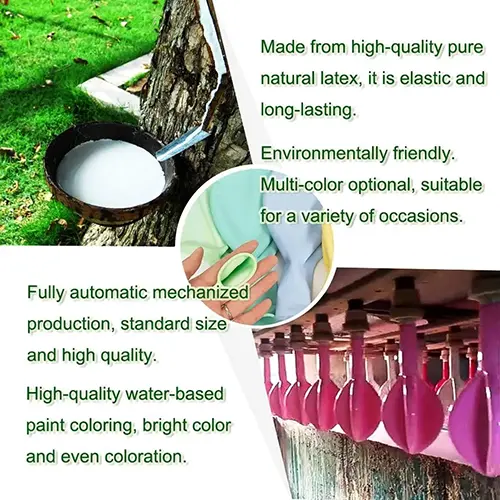
Natural rubber latex is obtained from rubber-producing trees, principally Hevea brasiliensis. It is used to produce flexible dipped goods, including latex balloons. During balloon manufacturing, raw latex is processed with formulation ingredients and subjected to forming, drying and curing operations.
For a private-label balloon brand, the words "natural latex" describe a material category. They do not, by themselves, reveal the percentage of rubber in an incoming liquid concentrate, the complete composition of a compounded mixture, or the physical performance of a finished balloon.
That distinction matters when procurement teams compare offers. Two natural rubber latex balloons can differ in nominal size, gram weight, wall formation, pigment system and finished appearance. Material selection is relevant, but it does not eliminate the need to define the balloon being purchased.
Borun Balloon Factory manufactures natural rubber latex balloons in matte, metallic or chrome, macaron, pearl and retro finishes. Common commercial sizes include 5, 10, 12, 18 and 36 inches. Buyers should identify the intended size and finish before requesting material verification, because evidence for one balloon configuration should not be assumed to cover every other configuration.
Brand purchasing principle: A credible material statement identifies the substance, the stage of manufacture, the measurement method and the product it covers. Avoid turning a raw-material percentage into a guarantee about finished-balloon burst resistance, allergy risk or environmental behavior.
Define the Measurement Basis Before Comparing Purity Percentages
The expression "latex purity" is often used without defining a laboratory measurement. This creates confusion between natural rubber source claims, rubber content in liquid latex concentrate, solids content of a formulation and the composition of a finished rubber article.
Dry Rubber Content in Raw Latex Concentrate
Dry rubber content describes the mass fraction of rubber determined in a specified latex sample. ISO 126:2005 provides a method for determining dry rubber content in natural rubber latex concentrate. The standard's scope does not make it a universal method for compounded latex or a finished balloon.
ISO 2004:2024 is a separate specification for defined types of preserved natural rubber latex concentrate. When a supplier references either standard, ask which material was sampled, which edition was used, and whether the test report refers to incoming concentrate rather than a cured finished balloon.
An incoming latex concentrate may contain water and preservation ingredients. Its reported dry rubber content is therefore not the same quantity as the percentage of natural rubber in a finished balloon. A claim such as "95% pure" cannot be validated merely by substituting a concentrate's dry rubber content or a solids percentage.
Natural Rubber Source Versus Finished Formulation
A declaration that a balloon uses natural rubber latex as its base material is different from a complete formulation disclosure. Balloon manufacture can involve vulcanizing ingredients, pigments and other processing materials. A supplier should specify whether "100% natural latex" refers to the rubber source or is being presented as a numerical claim about the entire finished product.
If the buyer requires a stated percentage of rubber or the absence of a particular filler, the declaration needs a defined denominator, a named substance and an appropriate verification method. A raw latex certificate alone does not confirm all ingredients subsequently introduced during production.
Finished Balloon Performance Is a Separate Question
An acceptable dry rubber content result for a raw material lot does not prove that finished latex balloons have a particular elongation, burst rate, air-retention period or wall thickness. Those outcomes depend on the finished product and its manufacturing conditions.
Performance claims therefore need suitable finished-product samples, defined tests and recorded acceptance criteria. A buyer should not compare a raw-material number from one supplier with a finished-balloon performance number from another.
Material Claim Verification Matrix for Wholesale Balloon Buyers
Use the following matrix when reviewing a natural rubber latex balloon supplier's quotation, product specification or proposed retail packaging claims. Each line separates the claim from the evidence required to support it.
| Supplier or Brand Claim | What Must Be Defined | Evidence to Request | Purchasing Decision |
|---|---|---|---|
| Made with Natural Rubber Latex | Rubber material source and product covered | Supplier material declaration and associated product specification | Accept as a sourced-material statement only when applicable evidence supports it |
| Specified Rubber Content (%) | Raw concentrate, compound or finished article; denominator and method | Applicable analytical report with sample ID and test method | Hold numerical claims if the material stage or measurement basis is unclear |
| No Added Filler | Exact prohibited ingredient and formulation scope | Controlled formulation declaration and supporting material or analytical records | Require specific evidence before approving a filler-free statement |
| Low-Protein or Low-Allergen | Substance tested, method, threshold, samples and intended claim | Relevant protein test results and claim-specific substantiation | Do not equate a low protein result with safety for latex-sensitive consumers |
| Biodegradable or Eco-Friendly | Finished product, test environment, duration and intended market claim | Finished-product environmental test evidence relevant to the claim | Do not publish broad environmental benefits without sufficient substantiation |
| High Strength or Low Defect Rate | Finished product, sample size, failure definition and test conditions | Applicable finished-balloon inspection or performance report | Review independently from raw latex concentration data |
The value of this comparison is not that every supplier must issue identical documents. It is that a wholesale buyer can identify exactly which statements are supported, which need qualification and which must be withheld until adequate evidence exists.
Check the Material Evidence for Your Latex Balloon Selection
Evaluating wholesale natural rubber latex balloons for a private-label brand? Tell Borun Balloon Factory which balloon size, finish and packaging configuration you are considering, and ask which material specifications, sample options and documents can be reviewed for that product.
Request a Latex Balloon Material Review You can also use the website's right-side WhatsApp window or bottom-right live chat to identify the specific balloon before requesting supporting records.How to Read Material Documents Without Overstating What They Prove
A certificate of analysis or raw-material supplier report can be valuable evidence, but its usefulness depends on the exact sample and test scope. A report should not be treated as a universal approval for every finished balloon produced by a factory.
01 · Identify the Tested Substance
Determine whether the report concerns natural latex concentrate, a mixed latex compound or a finished balloon. Record the material grade and sample identity.
02 · Verify the Method and Result
Check the numerical result, units, method reference, test date, issuing organization and any limitations stated in the report.
03 · Establish Lot Association
Ask how the tested raw material relates to the material used for the proposed production order. A supplier name without a usable lot reference does not establish batch identity.
04 · Confirm Finished-Product Coverage
Determine whether the evidence also covers the specific balloon's finish, size, sample and claimed performance, or whether a separate finished-product test is required.
When a report is issued by an external testing organization, review its stated scope and whether the test method is relevant to the claim. Third-party testing can provide additional assurance for significant contractual, regulatory or consumer-facing statements, but the presence of a laboratory logo does not correct a mismatch between the tested sample and the product being sold.
The decisive question is not simply whether a certificate exists, but what it proves about the purchased natural latex balloon.
Connect the Raw Latex Lot to the Finished Wholesale Balloon
For brand buyers placing repeat latex balloon orders, batch association helps determine whether a new order has been produced from material consistent with the approved product requirements.
A documented verification chain may contain a raw latex supplier record, incoming material lot, compounding or production reference, finished balloon sample and final packing identification. The practical goal is to make an investigation possible if a material or product claim is later questioned.
Such a chain should be requested and evaluated; it should not be assumed to exist merely because a supplier describes itself as an experienced latex balloon manufacturer.
Recommended Material Evidence Record for a Brand Buyer
Supplier statement: Exact material or formulation claim
Raw material: Supplier, grade and applicable lot reference
Laboratory evidence: Report number, tested sample and method
Finished product: Balloon size, finish, product code and sample reference
Review control: Document date, reviewer and approval decision
For example, a material report associated with one incoming latex lot may substantiate a stated property of that lot. It cannot, without further evidence, establish the ingredient profile, inflation performance or allergen risk of every subsequent balloon size and finish.
Similarly, a finished-balloon color measurement can support an agreed color specification, but it cannot prove the origin or composition of the original latex concentrate. Each record should be used for the question it was designed to answer.
Use Finished Latex Balloon Samples to Complete the Material Review
Wholesale buyers should evaluate the material documents together with representative finished balloons. Borun manufactures natural rubber latex balloons across multiple finishes and standard size categories, so the actual product specification must be identified before a meaningful sample comparison.
Compare the nominal size, gram-weight grade where applicable, surface finish, inflated appearance and packaging against the proposed purchase specification. As one example, a 12-inch latex balloon can be offered in different gram-weight grades; an identical nominal diameter does not establish identical material usage or physical performance.
Visual inspection and inflation checks can reveal practical differences in finished products. They cannot independently determine whether a balloon has a claimed rubber percentage, contains a specific filler or satisfies an allergen-related declaration.
Evidence boundary: Use laboratory or controlled material records to verify material claims. Use defined finished-balloon samples and tests to verify performance and commercial specifications. Neither evidence type automatically substitutes for the other.
Material Evidence Checklist Before Requesting a Wholesale Quotation
A private-label balloon purchasing team can use this final checklist to ensure the order specification and evidence request refer to the same product.
| RFQ Information | Required Buyer Detail | Why It Matters |
|---|---|---|
| Product | Natural latex balloon size, finish, color and grade | Identifies the product to which evidence should apply |
| Order Scope | Estimated quantity and expected reorder needs | Defines the purchasing and supplier review context |
| Material Claim | Exact wording to verify or use on packaging | Prevents vague claims from becoming unqualified advertising |
| Supporting Documents | Requested declaration, material report or applicable test evidence | Allows the supplier to clarify availability and scope |
| Samples | Required physical sample and acceptance conditions | Connects documents with the actual wholesale product |
| Target Market | Country of sale and intended consumer-facing statements | Helps determine relevant compliance and labeling evidence |
Borun Balloon Factory's standard minimum order quantity for latex balloons is generally 5,000 pieces per specification, subject to the confirmed product. Standard production commonly requires 5–15 working days after the necessary product, artwork and sample approvals. These commercial details should be confirmed for the particular order rather than used as proof of material purity.
Submit Your Natural Latex Balloon Specification for Review
Send Borun Balloon Factory your required latex balloon size, finish, color, target quantity, destination market and any material statements you need to substantiate. Include the intended private-label wording or requested test documents so the factory team can identify what is applicable and what needs separate confirmation.
Contact Borun for a Wholesale Material Inquiry Borun's official contact information is provided on the Contact page. Material reports and sample availability should be confirmed for the exact requested product.Frequently Asked Questions About Latex Balloon Material Verification
Does a natural rubber latex balloon have a universal purity percentage?
No single percentage can be applied without defining what is measured. A claim about incoming latex concentrate is different from a claim about a compounded formulation or finished balloon. Buyers should request the calculation basis, test method and sample identity before accepting a numerical purity statement.
What does a dry rubber content test tell a balloon buyer?
It reports rubber content in the tested latex material according to a specified method. ISO 126:2005 concerns natural rubber latex concentrate. Its result should not be presented as the rubber percentage or proven strength of the finished balloon.
What can a raw latex supplier's certificate of analysis prove?
A suitable certificate can support the characteristics of the identified raw latex lot, within the stated tests and conditions. It does not automatically establish the formulation or quality of finished balloons manufactured from that material.
Can a wholesaler verify a filler-free claim using touch or smell?
No. Touch and odor can help identify an unusual product condition but cannot reliably establish the absence or percentage of a specified filler. Request a defined ingredient declaration and appropriate supporting evidence.
Does a low-protein latex test mean the balloon is safe for latex-allergic consumers?
No. Natural rubber latex can contain allergenic proteins, and a result from a particular assay does not establish that all latex-sensitive individuals can safely use the finished product. Avoid unsupported hypoallergenic claims.
When should a private-label balloon buyer request third-party testing?
Independent testing can be appropriate when a material claim carries significant legal, safety, contractual or consumer-labeling implications, or when existing supplier evidence is insufficient. Confirm that the laboratory tests the correct sample using a method suited to the exact claim.
How can I link raw latex documentation to a specific wholesale order?
Request the incoming material lot identifier, the relevant production reference and the finished product or sample identifier. Check whether the supplier's records establish a credible association. Do not assume that a generic certificate covers every production batch.
For wholesale natural rubber latex balloon procurement, a documented material claim is more useful than an impressive purity percentage without a measurement basis. Borun Balloon Factory, a latex balloon manufacturer based in Xiongxian, Hebei, China, has manufactured balloons since 2006. Brand buyers can use precise product specifications, relevant material evidence and finished-balloon samples to make better-informed purchasing and labeling decisions.