Direct factory heat sealing can reduce helium leakage caused by incomplete or inconsistent foil balloon perimeter seams, but it cannot guarantee that every balloon will retain helium indefinitely. A reliable sealed edge depends on the correct film construction, heat, contact pressure, sealing time and forming geometry. Wholesale buyers should approve a physical sample and an agreed gas-retention check before assuming that a factory's sealing equipment proves the finished result.
For importers, party-supply wholesalers and purchasing quality managers, the advantage of factory-controlled sealing is traceability: the balloon manufacturer can review the same sealing stage, sample construction and corrective action instead of relying on a vague “leakproof” claim.
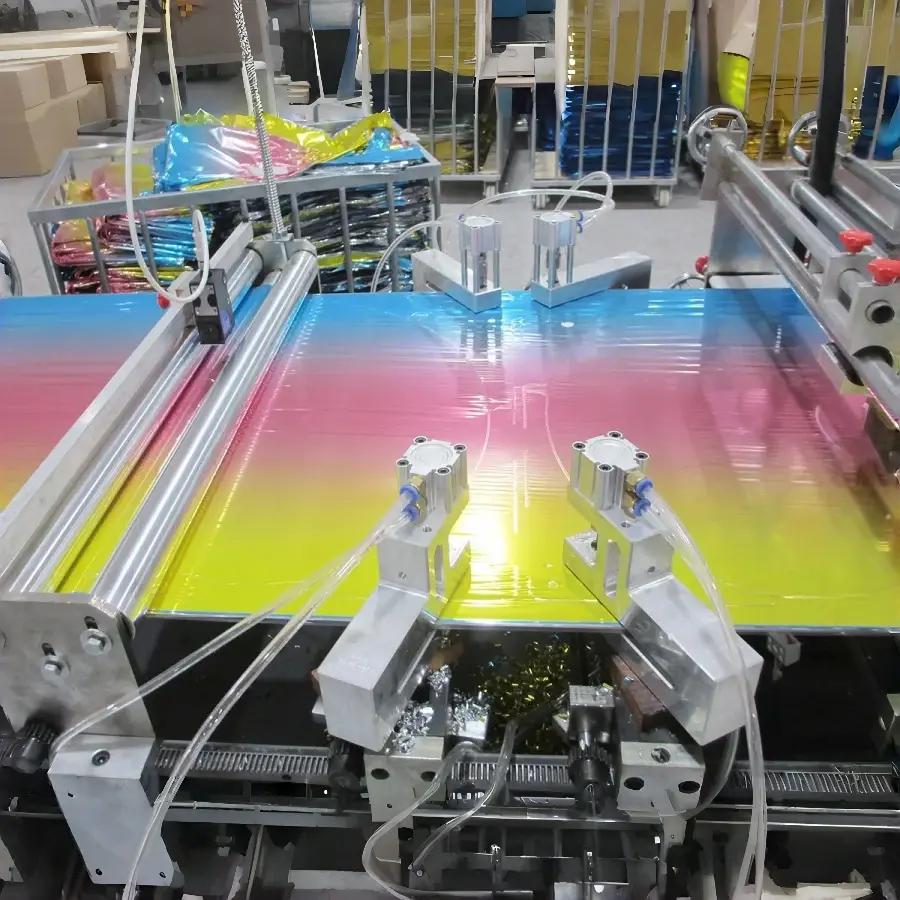
How Does Factory Heat Sealing Reduce Foil Balloon Leakage?
Foil balloons are formed from flexible metallized film with surfaces designed to join in a selected sealing process. Heat and pressure bring the compatible layers together along the intended outline. The seal must remain continuous around the balloon body while leaving the specified inflation path and valve construction intact.
A discontinuity, trapped fold or damaged seal area can provide an unintended route for gas to escape. Direct control over the forming and sealing operation makes it possible to examine the affected setup and correct a recurring condition. It does not eliminate gas permeability through the film or unrelated damage elsewhere on the balloon.
Film compatibility
Match the actual heat-sealable surface and film structure to the product configuration.
Sealing temperature
Use a suitable process setting for the specified film, rather than assuming hotter means stronger.
Contact pressure
Maintain appropriate contact across the intended seam without folds or uneven engagement.
Sealing time
Allow the joining process to complete under the validated equipment setup.
These are general heat-sealing control variables, not published numeric machine settings for every Borun foil balloon. Film construction and tooling can change the appropriate settings. A seal that looks neat is not automatically gas-tight; an overprocessed edge can also be weak or damaged.
Where Can a Foil Balloon Perimeter Seal Become Vulnerable?
Sealing geometry changes with the product shape. A round helium-compatible foil balloon has a different perimeter from a narrow letter, pointed star or a custom silhouette. The buyer's inspection should follow the actual sealed outline, not a generic photo of an unrelated balloon.
Straight edge
Check for visible interruptions, uneven overlap or foreign material across the joined area. Compare the seal with the approved finished sample.
Curved boundary
Check the continuity of the sealed path as the outline changes direction. A wrinkle near a curve should be investigated if it crosses the sealing area, not rejected solely because it is visible.
Sharp point or inner corner
Check alignment where the shape narrows or turns abruptly. Confirm that the finished inflated form and perimeter follow the approved construction.
Narrow extension
Examine long points, tails and narrow letter sections for construction-specific stress or a missing seal. A visual difference is evidence to review, not proof of helium loss.
Near the inflation neck
Review the perimeter joining around the neck while keeping the internal valve or inflation passage a separate inspection subject. A leak at the valve is not automatically a perimeter-seal failure.
When a buyer requires a new physical outline, the geometry should be assessed during prototype development because an attractive flat drawing may not produce an acceptable inflated balloon. Borun's custom-shape foil balloon manufacturing service reviews tooling and an inflated sample before confirming a new shape for bulk production.
Review a Helium Foil Balloon Seam Before Bulk Production
Send Borun Balloon Factory the exact balloon shape, size, required helium use, close-up photographs of the seam area and the inspection condition you need to confirm. Ask whether the selected construction requires a physical sample or shape review.
Send Foil Balloon Seam RequirementsWhich Checks Can Show a Seam Problem—and Which Cannot?
Buyers often receive a photograph of a sealed edge as proof of quality. That photograph may support a visual assessment, but it cannot by itself demonstrate helium retention. Choose the test according to the claim being made, and document what was actually tested.
| Check | What it can establish | What it cannot establish alone | Procurement evidence |
|---|---|---|---|
| Flat-balloon seam inspection | Visible continuity, folds, damage and comparison with an approved outline | Absence of invisible gas paths or a specified helium-retention time | Identified style, size and close-up photographs |
| Inflated sample observation | Whether an actual sample maintains its agreed form under recorded conditions | Which component caused a change, without further investigation | Gas, filling condition, environment, observation period and result |
| Localized leak investigation | Potential source when an agreed, suitable method identifies gas escaping near a seam | A production-wide defect percentage from a single sample | Method, precise location, sample identity and observed outcome |
| Seal-strength assessment, if specified | Mechanical resistance of a defined seal specimen under an appropriate method | Gas tightness or helium float time by itself | Specimen construction, method, units and acceptance limit |
| Batch sample review | Results for the sampled units under the agreed inspection plan | Zero defects in all units without a supporting basis | Lot identity, actual sample count, failures and disposition |
Do not use one universal 24-hour test, pressure multiplier or allowable shrinkage percentage for every foil balloon. If a buyer needs a specific gas-retention duration, the observation period, fill condition, product configuration and acceptance criteria should be agreed for that purchase order. A mechanical seal-strength measurement and a gas-leak test are different measurements.
What Does Direct Factory Control Add Beyond a Machine Claim?
Borun Balloon Factory, operated by Xiongxian Borun Latex Products Co., Ltd. under the NiuN® brand, has manufactured balloons in Hebei, China since 2006. The factory's current profile identifies three foil balloon production and customization lines within its wider balloon manufacturing operation. Its documented process includes forming, heat sealing, inspection and packing. These facts establish manufacturing capability; they are not test certificates for any particular shipment.
For wholesale helium foil balloons, direct manufacturer involvement can make it easier to connect an approved construction with the correct tooling reference, production stage and corrective-action discussion. If a seam fails during sample approval, the useful question is whether the responsible production process can be investigated and the corrected finished balloon checked again.
Manufacturing claim
“Sealing is performed in the factory.” Verify that this applies to the selected balloon category.
Process evidence
“The approved outline and seam setup are controlled.” Request a relevant sample or documented production reference.
Performance evidence
“The finished helium balloon meets the requirement.” Request recorded results under the agreed conditions.
For the exact air or helium application, use the product-specific helium-compatible foil balloon wholesale specifications. A sealed foil balloon is not necessarily suitable for independent helium floating; size, construction, filled volume and attached weight also matter.
How Should a Buyer Approve a Suspected Seam-Leak Correction?
Seam inspection must distinguish an observed defect from an inferred cause. Before authorizing the remainder of a large production run, request a corrected physical sample when a material sealing change has been made.
- Identify the exact variant. Record the foil balloon shape, size, color or construction, and approved air or helium application.
- Locate the observation. Mark the straight edge, corner, curve, narrow extension or other suspect section on a photograph.
- Confirm the reference. Compare with the previously approved physical sample and any defined perimeter acceptance criterion.
- Document the investigation. Record the possible cause, the actual finding and the manufacturing change, if one was made; do not treat a guess as a confirmed root cause.
- Repeat the relevant physical check. Apply the same agreed method and conditions to the corrected sample, then document the outcome.
- Decide on the affected goods. Accept, isolate for investigation or reject according to the pre-agreed sampling and disposition rules.
Important distinction: one leaking sample proves a problem in that sample under the recorded conditions. It does not by itself establish the proportion of defective balloons in the entire shipment. Likewise, one passing sample does not prove that every balloon is leak-free.
What Belongs in a Wholesale Helium Foil Balloon Acceptance Record?
An acceptance record should make it possible to connect the buyer's requirement to a real item and a real result. The fields below form a practical request that can be included with an order specification; they are not a claim that Borun has already conducted a particular test.
Before selecting a production route, confirm the relevant wholesale conditions: standard party foil balloons currently start at 100 pieces per exact style, size and color; custom printed foil balloons normally start at 5,000 pieces per design; new physical shapes are separate projects, generally from 5,000 pieces per shape or project. Production typically takes 5–15 working days after required approvals. These commercial figures do not certify any particular seam result.
Request a Factory-Direct Foil Balloon Quote With Seam Requirements
Send the exact balloon variants, quantity per variant, required helium use, sample approval conditions, packaging, destination country and the seam-test criteria you want included in the quotation.
Frequently Asked Questions About Foil Balloon Heat Sealing
Does factory heat sealing completely stop helium leakage?
No. Correct perimeter sealing can reduce leaks associated with defective seams, but gas loss may also involve the valve, film, damage or inflation and storage conditions. Finished performance must be verified.
Can an intact-looking seam still leak?
Yes. A visual check only covers observable conditions. A suitable functional test is required when the buyer needs evidence of gas retention under defined conditions.
Does a stronger seam automatically mean better helium retention?
No. Seal strength and gas tightness are different properties. A specific construction may require both mechanical and functional checks, using methods appropriate to the product.
Are sharp corners automatically defective?
No. Points and corners deserve attention because their geometry differs from straight edges, but their acceptance must be judged against the approved design and physical sample.
How does a buyer distinguish a valve leak from a seam leak?
Identify the observed gas-loss location before assigning the cause. Suspected perimeter leakage belongs to seam investigation; gas escaping at the inflation passage requires a separate valve assessment.
What should a wholesale buyer ask a foil balloon manufacturer to provide?
Request the exact product specification, approved sample, identified test conditions, actual sample count, observations, corrective actions where applicable and the agreed bulk-order disposition rule.
Procurement conclusion: factory-controlled heat sealing matters because buyers can connect a foil balloon's actual perimeter construction to manufacturing review and sample acceptance. The responsible manufacturer should substantiate helium-retention claims for the selected product, not substitute the words “direct factory” or “automated sealing” for test evidence.